How Long Does It Take to Build a Website? Real Timelines for Businesses in 2026
7 MINUTES READ
25 May 2026
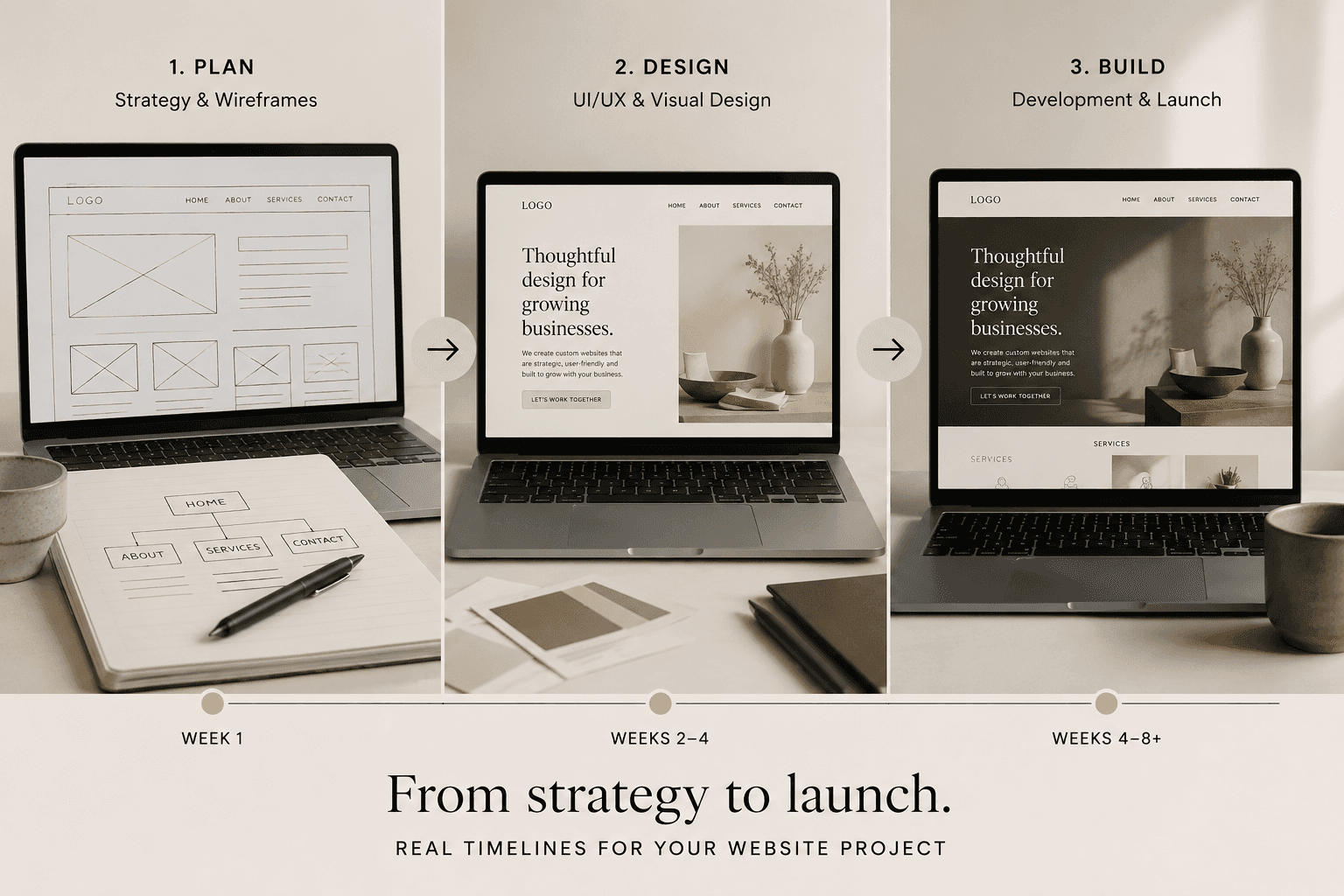
How long does it take to build a website? The answer depends on the size, complexity, and goals of the project, but most business websites take anywhere from a few weeks to several months to complete.
While a simple landing page or template-based build can move quickly, a fully custom business website with strategic UX, SEO, and advanced functionality naturally requires a longer timeline. Unrealistic expectations often come from underestimating how much planning, content preparation, revisions, and testing are involved behind the scenes.
For many businesses, the process also depends on whether they choose a custom vs template website approach and how much flexibility they need long term. A custom website typically takes longer because every layout, interaction, and feature is designed around the brand and user experience, while template-based builds are usually faster but more limited. Budget can also influence timelines, especially when businesses are comparing small business website cost options and deciding how much functionality, SEO preparation, and scalability they want included from the start.
Average Website Build Timelines for Different Business Sites
If you are asking how long does it take to build a website, the honest answer depends heavily on the type of website you need. A simple landing page for a campaign looks very different from a fully custom business website with strategic UX, SEO setup, and bespoke functionality. Businesses exploring professional custom web design services often assume all websites follow the same timeline, but scope is the biggest deciding factor.
As a general benchmark, template-based websites can often launch much faster, while custom builds naturally require more time for strategy, design, development, testing, and refinement. Ecommerce websites also tend to take longer because of product setup, payment integrations, shipping configuration, and user journey optimisation.
Website Type | Typical Timeline |
|---|---|
Single landing page | 1–2 weeks |
Template-based small business website | 2–4 weeks |
Custom small business website | 4–8 weeks |
Custom service business website with SEO setup | 5–10 weeks |
Ecommerce website | 6–12 weeks |
Advanced custom website with integrations | 8–16+ weeks |
Of course, these are realistic averages rather than guarantees. A highly organised business with ready content and quick approvals can move much faster, while projects with unclear scope or multiple revision rounds can easily stretch beyond the estimated timeline.
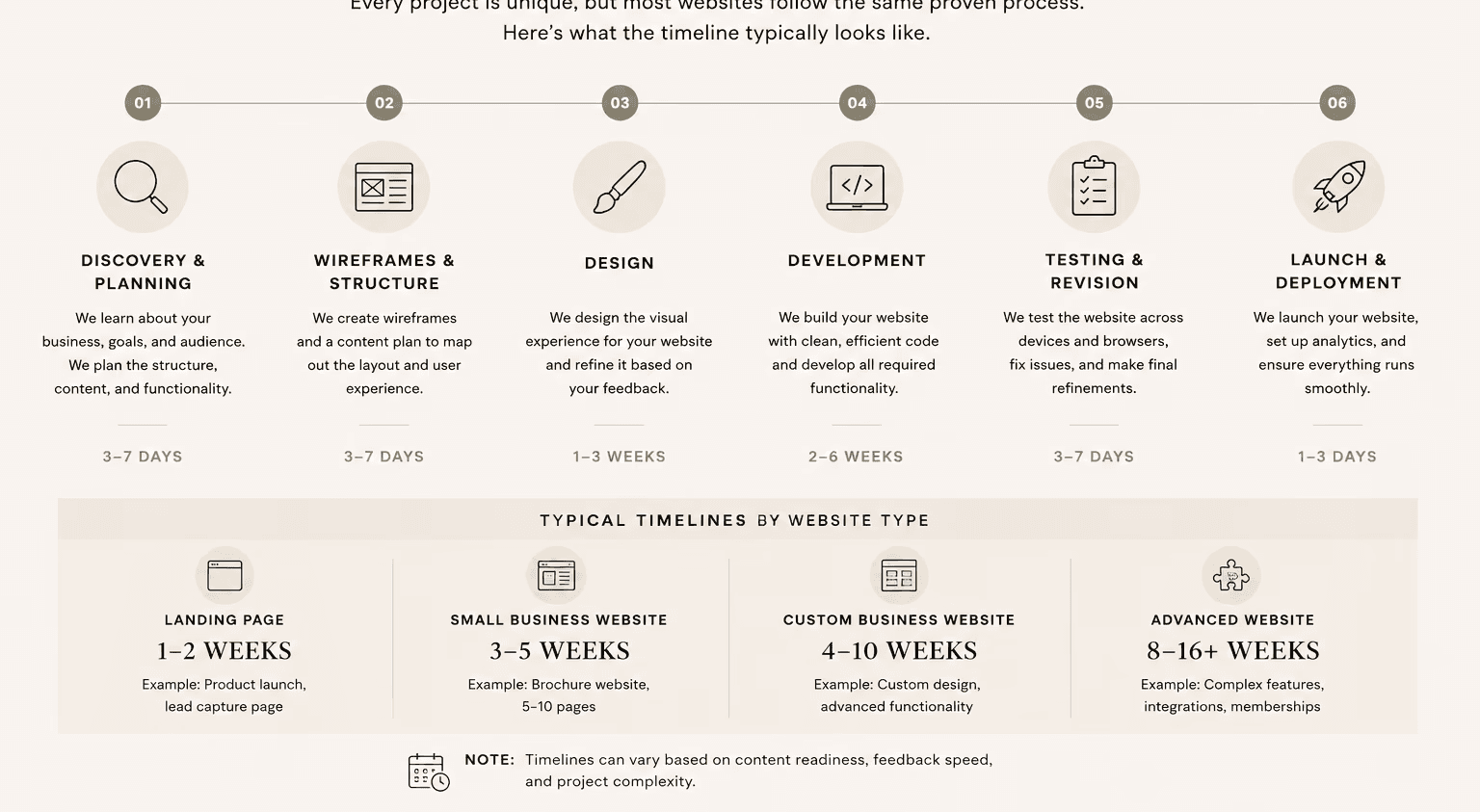
Single Landing Page (1–2 Weeks)
A single landing page is the fastest type of website project to complete, typically taking around 1–2 weeks when content and design direction are already clear. These websites are usually built around one specific goal, such as lead generation, promoting a service, or supporting a marketing campaign. When businesses ask how long does it take to build a website, the answer is often much shorter for projects with limited scope like this.
Key factors that keep timelines short include:
Minimal design complexity: With only one page to structure, there are fewer layout decisions, fewer content blocks, and significantly less development work.
Limited functionality: Landing pages rarely require advanced integrations, complex navigation, or custom backend features.
Faster SEO setup: Even smaller projects still benefit from a proper on-page SEO checklist for new websites, but implementation is naturally much faster than on larger builds.
Template-Based Small Business Website (2–4 Weeks)
A template-based small business website generally takes around 2–4 weeks to complete. This type of project uses an existing design framework that is customised with the business’s branding, content, imagery, and messaging. Many businesses choose this route when speed is the top priority.
Timelines are shorter because:
The design framework already exists: Designers are adapting rather than creating layouts entirely from scratch.
Development is more streamlined: Fewer custom components and less bespoke coding means faster implementation.
Decision-making tends to be simpler: With predefined structures, businesses spend less time debating layouts and user flows.
Template websites can be practical for simpler projects, but they naturally offer less flexibility than bespoke web design services built around long-term growth.
Custom Small Business Website (4–8 Weeks)
A custom small business website usually takes around 4–8 weeks, depending on the number of pages, functionality, and strategic requirements. Unlike templates, these websites are built specifically around the business’s goals, audience behaviour, and brand identity.
This timeline increases because:
Everything is designed intentionally: Layouts, content hierarchy, navigation, and conversion journeys all require strategic planning.
UX requires refinement: Strong UX optimisation means creating intuitive user journeys rather than simply making a website look attractive.
Testing takes longer: Custom small business website design require more responsive testing, refinement, and quality assurance across devices.
Businesses investing in professional custom web design services typically accept longer timelines because the final product is far more tailored and scalable.
Custom Service Business Website With SEO Setup (5–10 Weeks)
A service business website with strategic SEO preparation usually takes around 5–10 weeks. This type of project goes beyond aesthetics by integrating search visibility, technical structure, internal linking, and conversion planning from the start. Businesses investing in professional SEO web design services are typically building websites that are designed to attract qualified traffic and generate enquiries rather than simply function as digital brochures.
If you're wondering how long does it take to build a website that is built for long-term search visibility and lead generation, the timeline naturally increases because more strategic groundwork is required before launch.
That extra time often comes from:
SEO foundations being built in early: Metadata, content structure, crawlability, mobile performance, and internal linking require proper implementation.
Content planning taking longer: Service pages need strategic messaging, keyword alignment, and clear conversion intent rather than placeholder copy.
Conversion-focused structure: Contact flows, CTA placement, trust-building sections, and user journey planning all require thoughtful execution.
This is where higher-quality small business web design services often deliver significantly stronger long-term business results.
Ecommerce Web Design (6–12 Weeks)
An ecommerce website generally takes around 6–12 weeks, and larger online stores can take even longer depending on product volume and functionality. Compared to standard business websites, ecommerce web design projects involve far more technical components, customer journey considerations, and conversion-focused decision-making.
Longer timelines are usually driven by:
Product setup complexity: Product descriptions, categories, pricing, imagery, stock management, and product variations all need to be organised and uploaded properly.
Payment and shipping integrations: Secure checkout systems, payment gateways, tax settings, shipping logic, and order workflows add significant technical complexity.
More conversion testing: Strong ecommerce web design is not just about visual appeal, as mobile usability, checkout flow, and friction-free purchasing directly affect revenue.
Because ecommerce websites involve significantly more planning, testing, and optimisation than brochure-style websites, businesses should expect longer development timelines to ensure everything functions smoothly at launch.
Advanced Custom Website With Integrations (8–16+ Weeks)
Advanced custom websites with integrations often require 8–16+ weeks, sometimes longer depending on functionality. These are highly bespoke projects built around specific workflows, business systems, or technical requirements.
Timelines grow because:
Integrations increase complexity: CRM systems, booking tools, APIs, membership functionality, and automation all require technical coordination.
QA becomes far more intensive: More functionality means more opportunities for compatibility issues and bugs.
Scope tends to evolve: Businesses often refine requirements mid-project once they better understand what is possible.
When businesses ask how long does it take to build a website, advanced projects are where unrealistic expectations most commonly appear.
What Actually Affects How Long It Takes to Build a Website?
If you're still wondering how long does it take to build a website, the answer often has less to do with design alone and more to do with the decisions, scope, and technical requirements behind the project. Two businesses can both need a “website,” yet one launches in two weeks while the other takes two months because the actual requirements are completely different.
Website scope and page count: A five-page brochure website is naturally much faster to complete than a larger business website with multiple service pages, landing pages, case studies, and blog infrastructure. Businesses investing in custom web design often require more strategic page architecture, which increases planning, design, and development time.
Content readiness: One of the biggest project delays has nothing to do with development and everything to do with content. If copy, imagery, service descriptions, or product details are not prepared, timelines can quickly stall while teams wait for missing assets.
Design complexity: A template-based website with minimal visual changes can move relatively quickly, while fully bespoke projects require far more strategic design work. Custom layouts, interactive elements, animations, and stronger branding naturally extend production timelines.
Functionality and integrations: Features like booking systems, CRM integrations, advanced forms, payment processing, multilingual functionality, or custom automation add meaningful technical complexity. The more moving parts a website has, the more development, testing, and troubleshooting are required.
SEO requirements: Websites built with long-term visibility in mind often take longer because search optimisation needs to be integrated from the beginning rather than added after launch. Technical structure, metadata, internal linking, content hierarchy, and broader SEO implementation all require additional planning and execution.
Revision rounds and decision-making: Projects move significantly faster when there is one clear decision-maker providing timely feedback. Multiple stakeholders, unclear direction, or repeated design revisions can quietly add weeks to even relatively simple builds.
Testing and quality assurance: Launching a website is not simply about finishing the design. Cross-browser checks, mobile responsiveness, form testing, performance optimisation, and bug fixes all take time, especially for larger or more custom websites.
How to Speed Up the Website Build Process Without Sacrificing Quality?
If you're asking how long does it take to build a website, the good news is that businesses can often shorten timelines significantly by preparing properly before the project begins. While some factors depend on technical complexity, many delays come from avoidable bottlenecks like unclear scope, missing content, or slow approvals. If you're planning a new project and want a realistic timeline, our contact page is the best place to discuss your requirements.
Prepare your content early: Final website copy, service descriptions, imagery, testimonials, and branding assets should ideally be ready before design begins. Waiting on content is one of the most common reasons website timelines quietly stretch by weeks.
Define project scope from the start: Clear expectations around page count, required functionality, integrations, and design direction help prevent mid-project surprises. Scope changes after development begins almost always create delays.
Assign one clear decision-maker: Projects move much faster when one person is responsible for approvals and feedback. Multiple stakeholders with conflicting opinions can dramatically slow even straightforward builds.
Choose the right website approach: A template-based project can launch faster than a fully bespoke build, while more strategic custom web design for small businesses naturally requires additional time. Aligning your expectations with the right type of project helps avoid frustration later.
Respond quickly during revision stages: Feedback bottlenecks can add more time than actual development work. Fast approvals help maintain momentum and keep launch dates realistic.
Think about SEO from day one: Adding technical SEO, metadata, and internal linking after launch is far less efficient than building these elements into the website from the beginning. Early planning creates a smoother process and stronger long-term results.
Final Thoughts: How Long Does It Take to Build a Website?
So, how long does it take to build a website? For most businesses, the answer depends entirely on the scope, complexity, and long-term goals of the project. A simple landing page may launch within days, while a strategic custom website or ecommerce web design project can take several weeks or even months to execute properly.
The most important takeaway is that faster is not always better. A well-planned website built with strong UX, SEO foundations, and clear business objectives will almost always deliver better long-term results than a rushed launch focused purely on speed.
Frequently Asked Questions
How long does it take to build a website?
If you're wondering how long does it take to build a website, the answer depends on the size, complexity, and requirements of the project. Simple websites may take a few weeks, while custom business websites, ecommerce stores, and more advanced projects can take several months to complete.
Can you make a website in 3 days?
In some cases, yes. A simple landing page or basic template-based website can sometimes be built within a few days. However, businesses searching for how long does it take to build a website are often planning projects that include custom design, SEO preparation, content planning, and testing, which usually require significantly more time.
Why does a custom website take longer to build?
Custom websites require more planning, design, UX strategy, development, testing, and refinement. Unlike template-based websites, every element is built around the business, its goals, and its target audience.
What is the biggest cause of website project delays?
One of the most common causes of delays is missing content. Website copy, imagery, stakeholder feedback, approval processes, and changes to the project scope can all extend timelines considerably. This is particularly common during a website redesign for small business projects, where businesses often update branding, services, messaging, and website structure at the same time.
How long does it take to build an ecommerce website?
Most ecommerce websites take between 6 and 12 weeks to complete, depending on the number of products, integrations, payment systems, shipping setup, and overall project complexity.
Does SEO increase the time it takes to build a website?
Yes, incorporating SEO into a website project can increase timelines slightly because it involves keyword research, content planning, metadata implementation, internal linking, and technical optimisation. However, building SEO foundations from the start often leads to stronger long-term results.
BLOG