Website Redesign Checklist for SMEs: 10 Things to Review Before Relaunching
7 MINUTES READ
26 May 2026
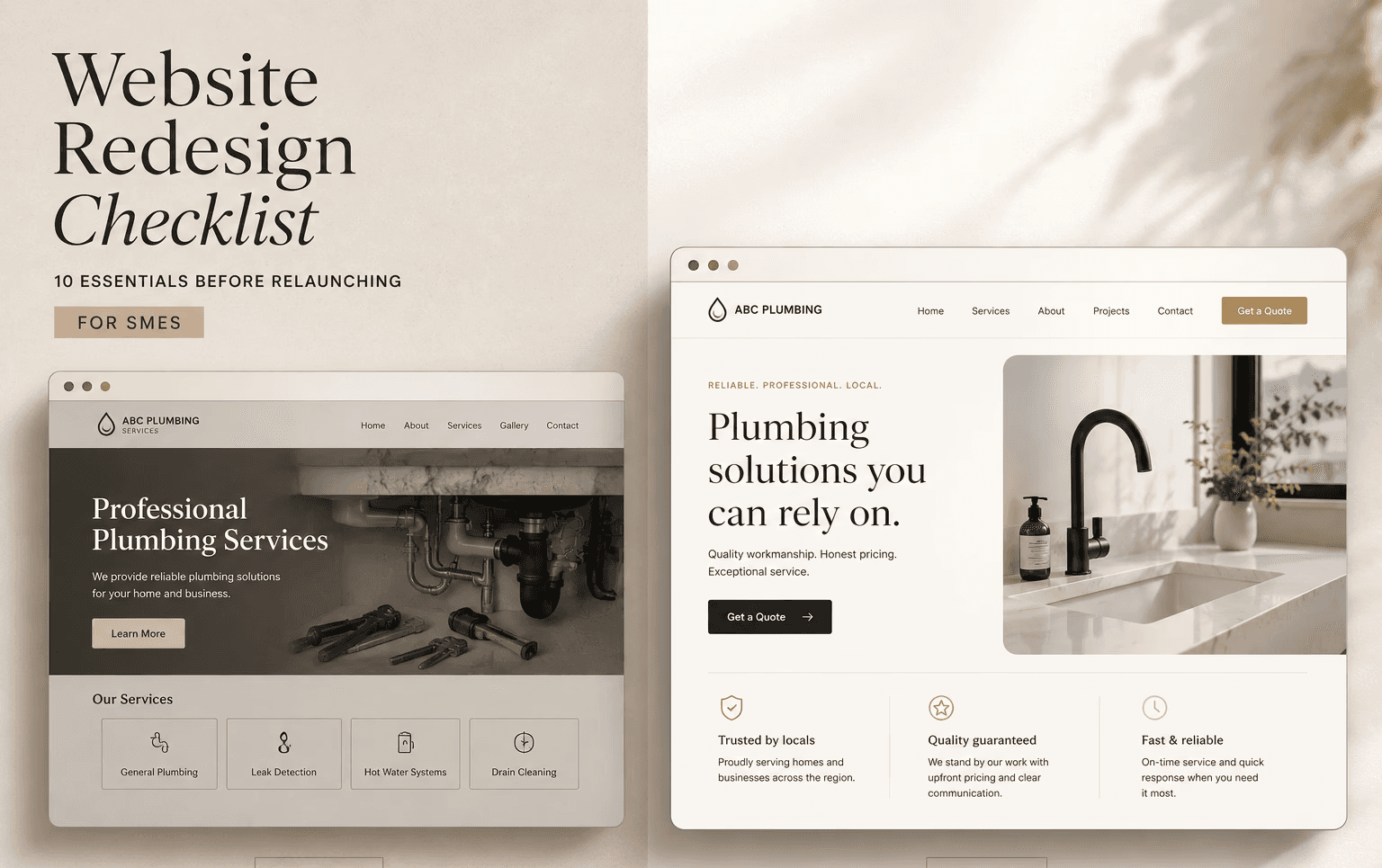
A website redesign checklist helps SMEs avoid the common mistake of treating a redesign as a purely visual update. While a fresh look matters, redesigning a business website should also improve usability, protect existing SEO performance, and make it easier for potential customers to take action. Without a clear plan, even well-intentioned redesigns can lead to broken pages, lost rankings, and lower conversion rates.
Whether you are considering professional website redesign services or reviewing your current site in-house, taking a structured approach can save time, money, and unnecessary setbacks. From mobile responsiveness and page speed to content strategy and user journeys, website redesign for SMEs should focus on business outcomes, not just aesthetics. This checklist covers the essentials to review before relaunching so your new website performs as well as it looks.
Who needs website redesign services?
A website redesign checklist for SMEs is most useful when a business has outgrown its current website or when performance issues start affecting visibility, usability, or conversions. Website redesign services are not only for companies with obviously outdated designs.
Whether you are using a custom or template website, the more important question is whether your current site still supports your goals, reflects your brand properly, and makes it easy for customers to take action.
Your website looks outdated: Design is often the first impression potential customers have of your business, and an older-looking site can make even a strong company feel less credible. One of the clearest signs a website needs a redesign is when competitors offer a noticeably more polished and modern online presence.
Mobile usability is poor: If visitors need to zoom, struggle with navigation, or encounter awkward layouts on mobile devices, your website is creating unnecessary friction. Since so much SME traffic comes from smartphones, mobile responsiveness should be a core part of any website redesign checklist for SMEs.
Your site loads slowly: Speed affects both user experience and search visibility, which makes performance a practical reason to consider website redesign services. If your site feels sluggish despite repeated fixes, the underlying structure may need a more strategic redesign rather than surface-level adjustments.
You are not getting leads or enquiries: A website can attract traffic and still underperform if the user journey is unclear or UX conversion optimisation is weak. Poor calls to action, confusing layouts, or badly structured service pages are all common signs a website needs a redesign.
Updating content is frustrating: If making simple changes feels overly technical or time-consuming, your website may no longer support the way your business operates. Whether you currently rely on a custom vs template website, usability behind the scenes matters just as much as front-end design.
Your business has evolved: Many SMEs expand services, refresh branding, or shift target audiences over time, while their websites remain stuck in an earlier version of the business. Professional website redesign services ensure your site reflects your current positioning and supports future growth.
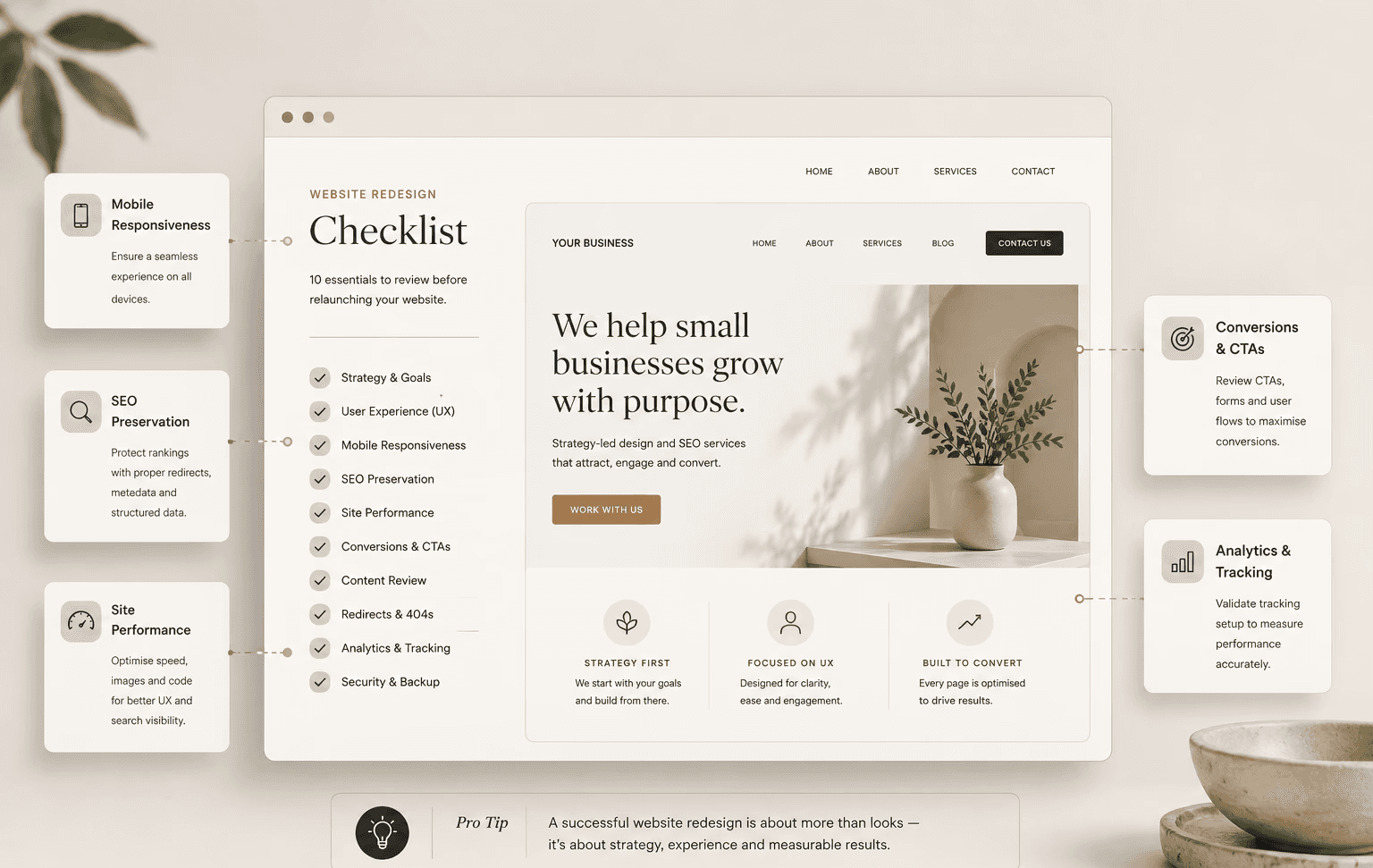
Website Redesign Checklist for SMEs: What to Review Before Relaunching?
A website redesign checklist helps SMEs approach a relaunch strategically rather than treating it as a purely visual refresh. While aesthetics matter, an effective redesign should also improve usability, protect SEO performance, and create a stronger path toward enquiries or sales.
Whether you are considering professional custom web design services or simply evaluating your current setup, reviewing the fundamentals first can prevent expensive mistakes later. This is especially important when budget planning is part of the process, since understanding how much a small business website costs often depends heavily on the scope, technical requirements, and long-term goals behind the redesign.
Review Your Current Website Performance Before Redesigning
A website redesign checklist should always start with understanding how your current website is actually performing. Many SMEs jump straight into redesign decisions based on appearance alone, only to overlook pages that already attract traffic or convert well. Before investing in website redesign services, review your analytics, search visibility, and user behaviour to identify what should be improved, preserved, or removed entirely. A strategic website redesign for SMEs should be informed by evidence rather than assumptions.
Traffic performance: Identify which pages bring the most organic traffic so you do not accidentally weaken strong-performing content during the redesign.
Conversion data: Review where enquiries, bookings, or contact form submissions are coming from, since redesigning without understanding conversion sources can hurt business results.
User behaviour: Analyse bounce rates, time on page, and navigation paths to spot friction points affecting engagement.
Protect Existing SEO Before Launching a Redesign
A website redesign checklist is incomplete without SEO protection planning. One of the most common mistakes businesses make is launching a redesigned site that looks better but quietly loses rankings because technical SEO fundamentals were ignored. If your business relies on search visibility, preserving existing SEO performance should be a priority, whether handled internally or through SEO optimisation services. Website redesign services should improve discoverability, not reset it. f you are reviewing broader optimisation fundamentals as part of the relaunch, our on-page SEO checklist for new websites is also a useful resource.
Redirect mapping: Old URLs should redirect properly to new pages to preserve rankings and avoid broken links.
Metadata preservation: Review title tags, meta descriptions, heading structures, and internal linking before migration.
Indexing checks: Ensure the redesigned website is crawlable and not accidentally blocked from search engines after launch.
Audit Mobile Responsiveness and User Experience
A practical website redesign checklist for SMEs must account for mobile usability, since a large portion of visitors now arrive via smartphones. A website that feels polished on desktop but frustrating on mobile creates unnecessary drop-off. Strong website redesign services should prioritise responsive layouts, clear navigation, and intuitive browsing behaviour across all screen sizes. Good design should make action easier, not harder.
Navigation clarity: Menus should remain easy to access and understand on smaller screens.
Tap usability: Buttons, forms, and interactive elements should be simple to use without zooming or accidental clicks.
Visual hierarchy: Important information should remain easy to scan and prioritised correctly on mobile layouts.
Improve Website Speed and Performance
Website performance should be treated as a business priority rather than a purely technical consideration. Slow-loading websites create friction for visitors, reduce conversions, and can negatively affect search visibility over time. For many SMEs, a redesign is the ideal opportunity to fix long-standing speed issues that patchwork updates have failed to solve properly. Whether you are investing in custom web design services or taking a lighter website redesign approach, performance improvements should be planned intentionally rather than left as an afterthought.
Image optimisation: Oversized images are one of the most common causes of slow business websites, particularly when visual assets have not been compressed properly for web use.
Code efficiency: Bloated scripts, unnecessary plugins, outdated integrations, or poor structural decisions can quietly slow down even visually attractive websites.
Performance testing: Test loading speeds across desktop and mobile using tools like Google PageSpeed Insights before and after relaunch so improvements can be measured rather than assumed.
Reassess Website Structure and Navigation
Many SMEs evolve over time, adding services, changing messaging, or targeting new audiences while navigation becomes increasingly cluttered. Strong website redesign services for SMEs should simplify user journeys, improve discoverability, and make important information easier to find. If you are investing in custom web design rather than surface-level cosmetic updates, structural improvements should be a core priority rather than an afterthought. A well-planned website redesign checklist should always include navigation and content architecture review.
Service organisation: Group related offerings clearly so visitors can quickly understand what your business does and move naturally toward relevant pages or enquiry points.
Navigation simplicity: Reduce unnecessary menu complexity, remove outdated or redundant pages, and prioritise the information users are most likely to need first.
Internal linking: Connect related pages strategically to improve usability, strengthen SEO foundations, and help search engines better understand your website structure.
Refresh Messaging, Branding, and Website Content
Website redesign for SMEs should not focus purely on layout changes if the messaging itself no longer reflects the business. Even a visually polished website can underperform if the copy feels generic, outdated, or unclear. A website redesign checklist should include content review alongside design decisions, especially when investing in custom web design services that aim to support long-term growth and stronger positioning.
Value proposition clarity: Visitors should understand what you offer within seconds of arriving.
Outdated content: Remove old service descriptions, expired offers, or messaging that no longer reflects the business.
Trust signals: Refresh testimonials, credentials, case studies, and supporting credibility elements where relevant.
Strengthen Conversion Paths and Calls to Action
Website redesign for SMEs should focus on business outcomes, not just visual improvements. Some businesses attract steady traffic but still struggle to generate meaningful enquiries because the website does not guide visitors clearly toward action. Professional website redesign services should improve conversion pathways through stronger calls to action, clearer contact flows, and more intentional page structure. Whether you are refreshing an existing site or investing in professional web design services, conversion optimisation should be treated as a practical priority.
CTA clarity: Visitors should always understand the next logical step, whether that means booking a consultation, requesting a quote, or getting in touch for more information.
Form usability: Contact forms should feel simple, accessible, and friction-free, without asking for unnecessary information that discourages enquiries.
Conversion placement: Calls to action should appear naturally throughout the user journey rather than being hidden at the bottom of a page where fewer visitors will see them.
Review Technical Essentials Before Relaunch
Even a visually strong redesign can underperform if important technical details are missed before launch. Broken forms, dead links, missing analytics, or indexing issues can quietly create problems from day one. A proper relaunch should include practical quality checks so the new site works smoothly for users and gives you reliable data after going live.
Broken link testing: Ensure internal links, buttons, menu items, and navigation paths all lead to the correct pages.
Tracking setup: Confirm analytics, event tracking, contact form tracking, and any relevant integrations are properly configured before launch.
Functional QA: Test forms, mobile layouts, interactive elements, contact flows, and key user journeys thoroughly before publishing the redesigned website.
Decide Whether Your Current Platform Still Fits
Not every redesign requires moving to a new platform, but some businesses eventually run into limitations that make future improvements harder than they should be. If your website feels restrictive, difficult to manage, or unable to support growth, the issue may be structural rather than purely visual. In some cases, website redesign services for SMEs involve more than refreshing layouts and instead require a broader rebuild that better supports long-term business goals.
Editing flexibility: Consider whether your team can make routine content updates efficiently or whether even simple edits feel unnecessarily time-consuming.
Structural limitations: Assess whether your current setup creates avoidable barriers around design flexibility, functionality, or long-term website improvements.
Growth compatibility: Think beyond the immediate redesign and evaluate whether the platform can realistically support future services, content expansion, or changing business needs.
Plan for Future Business Growth
A strong redesign should look beyond immediate launch goals and focus on long-term usability. Many businesses redesign their websites to solve current frustrations, only to realise a year later that the new structure already feels limiting again. Whether you plan to add services, publish more educational content, expand into new markets, or strengthen lead generation, the website should be built with flexibility in mind. This is also where practical planning matters, since decisions around scalability can directly influence how long it takes to build a website and the complexity of the overall project.
Service expansion: Ensure the website structure can accommodate future offerings without becoming cluttered or difficult to navigate.
Content scalability: Leave room for blogs, FAQs, resources, or other supporting content that may become valuable as the business grows.
Business flexibility: Consider integrations, multilingual functionality, and evolving conversion goals when planning for long-term growth.
Website Redesign vs Website Refresh for SMEs
Website redesign for SMEs does not always mean starting from scratch. In some cases, a lighter website refresh can solve immediate visual or usability issues without requiring a full structural rebuild.
The right choice depends on the condition of the current website, your business goals, and whether the underlying platform still supports growth. Understanding the difference helps SMEs invest more strategically rather than overcommitting to changes they may not actually need.
Factor | Website Refresh | Website Redesign |
|---|---|---|
Scope | Visual updates, minor UX improvements, content tweaks | Structural rebuild, UX overhaul, navigation changes, technical improvements |
Time Investment | Faster to complete | Longer project timeline |
Cost | Lower upfront investment | Higher investment depending on scope |
SEO Impact | Usually minimal if handled carefully | Requires proper SEO planning and redirects |
Performance Improvements | Limited if structural issues remain | Greater opportunity for speed and technical optimisation |
Platform Limitations | Existing restrictions remain | Opportunity to address deeper limitations |
Scalability | Short-term improvement | Better for long-term growth planning |
Best For | Websites that still function well but feel visually dated | Websites with UX, SEO, performance, or structural problems |
A website refresh is often the better option for businesses with a solid technical foundation that simply need updated visuals, refreshed messaging, or lighter usability improvements. A full website redesign makes more sense when deeper issues are affecting performance, lead generation, scalability, or search visibility. If your website feels outdated but still functions well, a refresh may be the smarter investment. If the problems go beyond aesthetics, redesigning properly is usually the more sustainable long-term decision.
How Long Do Website Redesign Projects Take?
The timeline for website redesign services depends heavily on the size, complexity, and goals of the project. A lighter website refresh may take only a few weeks, while a more strategic redesign involving content restructuring, SEO planning, and technical improvements will naturally take longer.
For SMEs, understanding realistic timelines helps with planning, budgeting, and setting expectations, especially when the redesign is tied to launches, campaigns, or broader business changes. If you have already worked through a website redesign checklist for SMEs, it becomes much easier to estimate scope accurately and avoid unexpected delays later in the process.
Project Type | Typical Timeline | Best Suited For |
|---|---|---|
Website Refresh | 2–4 weeks | Businesses needing visual updates and minor UX improvements |
Standard SME Redesign | 4–10 weeks | Service-based SMEs needing strategic design, UX, and structural improvements |
Complex Website Redesign | 8–16+ weeks | Larger websites with advanced functionality, SEO migration, or technical rebuilds |
Simple Website Refreshes
A lighter refresh focused on visual updates, content tweaks, and minor usability improvements can often be completed relatively quickly. If the website structure remains largely intact and no major technical work is required, timelines are usually shorter and less disruptive to day-to-day operations. This option works best when the core website still performs reasonably well and only targeted improvements are needed.
Typical timeline: 2–4 weeks
Best suited for: Visually outdated websites with solid technical foundations
Main variables: Number of pages, content updates, approval speed
Standard SME Website Redesign Projects
This is often the most realistic scope for businesses investing in website redesign services because it goes beyond surface-level visual changes. A standard website redesign typically includes mobile UX improvements, stronger conversion planning, updated messaging, technical QA, and structural improvements identified during earlier planning. For many growing SMEs, this delivers the best balance between meaningful impact and realistic timelines.
Typical timeline: 4–10 weeks
Best suited for: Service-based SMEs needing strategic website improvements
Main variables: Design complexity, page count, stakeholder feedback, integrations
Larger or More Complex Redesigns
Projects involving extensive SEO migration, multilingual content, larger content libraries, advanced integrations, or deeper structural rebuilds naturally require longer timelines. These projects involve more planning, implementation, testing, and refinement before launch, particularly where technical SEO or complex user journeys are involved.
Typical timeline: 8–16+ weeks
Best suited for: Larger or technically demanding business websites
Main variables: SEO migration, integrations, custom functionality, content complexity
What Can Delay a Website Redesign?
Even well-planned projects can slow down when decision-making, content approvals, or scope changes create bottlenecks. In practice, internal delays often affect project timelines just as much as technical execution, particularly when project requirements evolve mid-build.
Content bottlenecks: Missing copy, delayed approvals, or unclear messaging decisions
Scope expansion: Adding extra pages or new functionality after work has already started
Feedback delays: Slow stakeholder responses or repeated revision rounds that extend delivery timelines
Common Website Redesign Mistakes SMEs Should Avoid
Even well-intentioned redesigns can underperform when important decisions are rushed or made for the wrong reasons. A website redesign checklist for SMEs helps reduce avoidable mistakes, but businesses still commonly overlook areas that directly affect performance, usability, and long-term results.
Whether you are handling changes internally or working with website redesign services for SMEs, avoiding these common pitfalls can make the difference between a smoother relaunch and an expensive disappointment.
Redesigning for aesthetics alone: A website that looks modern but fails to improve usability, conversions, or business messaging will rarely deliver meaningful results. Design should support business goals, not exist purely for visual appeal.
Ignoring existing SEO performance: Changing URLs, removing strong-performing pages, or launching without redirect planning can damage search visibility quickly. SEO should be considered early rather than treated as a post-launch fix.
Keeping outdated content: Fresh visuals will not solve weak messaging, generic service descriptions, or outdated trust signals. A redesign should be an opportunity to improve communication as well as appearance.
Overcomplicating navigation: Businesses sometimes try to include too much in menus or page structures, creating confusion instead of clarity. Simpler user journeys often produce better engagement and conversion outcomes.
Weak calls to action: Even attractive websites can underperform when visitors are not clearly guided toward the next step. Enquiry forms, booking prompts, and service CTAs should feel intentional and easy to find.
Skipping mobile testing: A redesign that looks polished on desktop but performs poorly on mobile creates immediate friction for a large share of users. Mobile usability should never be treated as secondary.
Launching without proper QA: Broken forms, dead links, missing analytics, or layout issues can quietly undermine performance from day one. Thorough testing before launch is one of the simplest ways to avoid preventable problems.
How Much Do Website Redesign Services Cost for SMEs?
Website redesign costs vary significantly depending on project scope, complexity, and business goals. A lighter refresh focused on visual improvements will naturally cost less than a full redesign involving UX restructuring, SEO planning, technical improvements, and content updates.
For SMEs, understanding typical cost ranges helps with realistic budgeting and makes it easier to decide whether a refresh or a more strategic redesign makes better business sense.
Project Type | Typical Cost Range | Best Suited For |
|---|---|---|
Website Refresh | $1,200–$4,000+ | Businesses needing visual updates and minor usability improvements |
Standard SME Redesign | $4,000–$12,000+ | Service-based SMEs needing structural, UX, and conversion improvements |
Complex Website Redesign | $12,000+ | Larger websites with advanced functionality, SEO migration, or deeper technical requirements |
Pricing depends on far more than visual design alone. Page count, custom functionality, SEO migration, content creation, integrations, multilingual requirements, and approval timelines can all influence the final cost. SMEs should focus less on finding the cheapest redesign and more on whether the investment solves meaningful business problems and supports future growth.
Final Thoughts on Website Redesign Checklist for SMEs
A well-planned website redesign for SMEs should do far more than improve appearance. From protecting SEO performance and improving mobile usability to strengthening conversions and preparing for future growth, the most effective redesigns are built around clear business goals.
Following a structured website redesign checklist helps reduce costly mistakes and makes decision-making far more strategic. Whether you need a lighter refresh or full website redesign services, the right approach depends on your current website’s limitations, growth plans, and user needs. A successful redesign should leave your business with a website that performs better, not just looks newer.
Frequently Asked Questions
What is a website redesign checklist for SMEs?
A website redesign checklist for SMEs is a structured framework that helps businesses review design, SEO, usability, performance, content, and conversion elements before relaunching a website. It helps reduce costly mistakes and ensures the redesign supports long-term business goals.
When should an SME consider a website redesign?
Businesses should consider a redesign when their website looks outdated, performs poorly on mobile devices, loads slowly, struggles to generate enquiries, or no longer reflects the company's services, branding, or growth objectives.
What should be included in a website redesign checklist for SMEs?
A website redesign checklist for SMEs should include SEO preservation, mobile responsiveness, website speed, navigation structure, content review, conversion optimisation, technical testing, and future scalability planning.
How long do website redesign projects typically take?
Most SME website redesign projects take between 4 and 10 weeks, depending on the size of the website, the complexity of the redesign, content requirements, and stakeholder approval processes.
Can a website redesign improve SEO performance?
Yes. A properly planned redesign can improve search visibility by strengthening website structure, page speed, mobile usability, internal linking, and overall user experience. However, SEO should be considered throughout the redesign process to avoid losing existing rankings.
What is the difference between a website refresh and a website redesign?
A website refresh focuses on visual updates and minor usability improvements, while a website redesign involves deeper structural, UX, technical, and content changes designed to improve overall website performance and support long-term growth.
BLOG