Why Your Website Is Getting Traffic but No Leads (And How to Fix It)
7 MINUTES READ
20 JUNE 2026
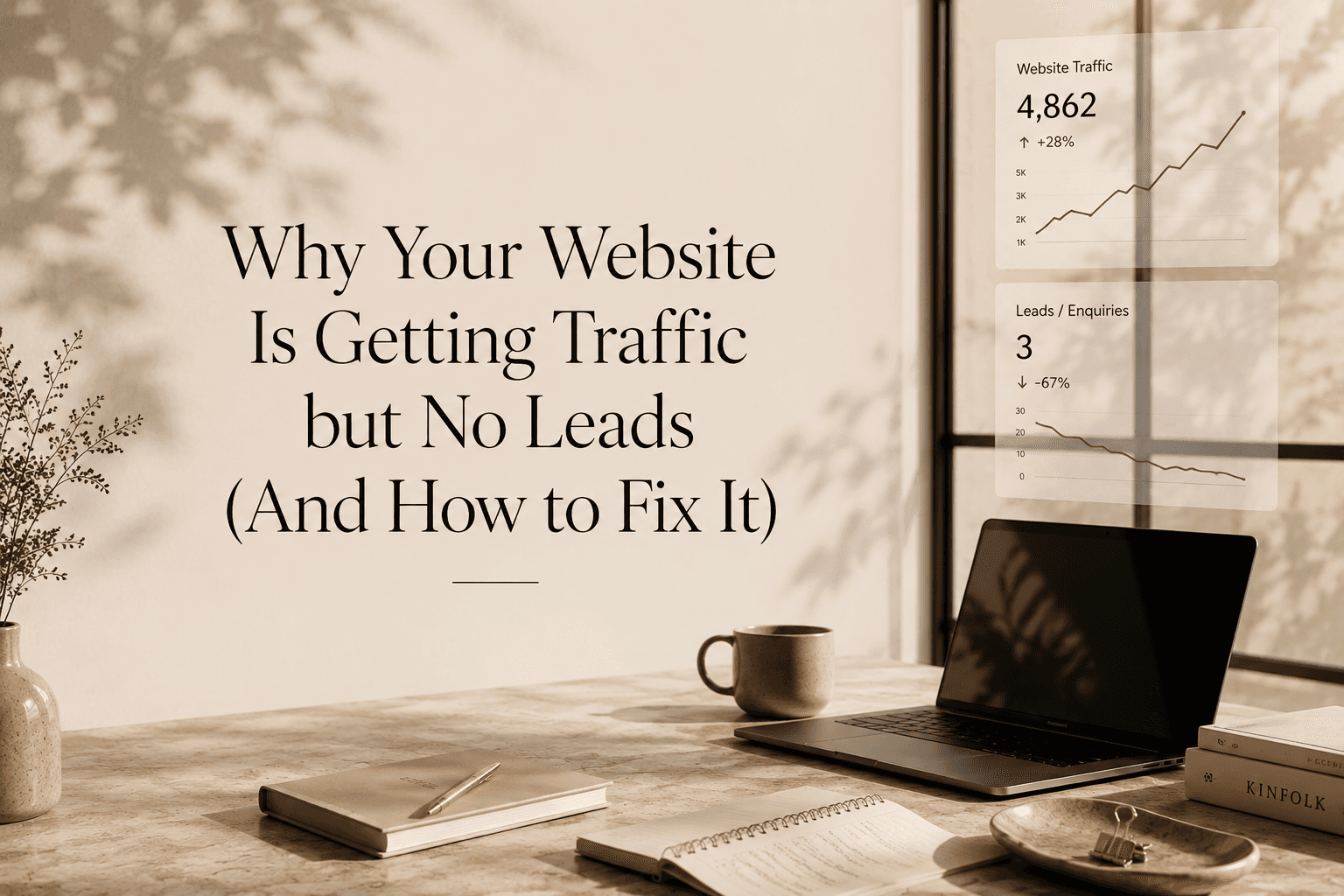
Why your website is getting traffic but no leads is one of the most frustrating problems small business owners face. Seeing visitors arrive on your website can feel like progress, but traffic alone does not grow a business.
Over the years, we've seen many websites attract a steady stream of visitors while generating very few enquiries. In most cases, the issue isn't visibility but what happens after someone lands on the site. If you're wondering why your website is getting traffic but no leads, the answer often comes down to messaging, user experience, trust, and conversion strategy. In this guide, we'll explore the most common causes and how thoughtful small business web design can help turn more visitors into customers.
Key Takeaways
High website traffic does not automatically translate into enquiries or sales.
The wrong type of traffic can lead to low conversion rates, even when visitor numbers are growing.
Weak messaging, unclear calls to action, and poor user experience are common reasons websites fail to generate leads.
Trust signals such as testimonials, reviews, and case studies play an important role in converting visitors into customers.
Improving conversion rates is often more effective than simply focusing on increasing traffic.
Small changes to website design, content, and user journeys can significantly improve lead generation results.
What Is Conversion Rate Optimization (CRO)?
Conversion Rate Optimization (CRO) is the process of improving your website so that a higher percentage of visitors take a desired action, such as submitting a contact form, requesting a quote, booking a consultation, or making a purchase. Rather than focusing solely on increasing traffic, CRO focuses on getting better results from the visitors you already have.
For example, if 1,000 people visit your website each month but only a handful make an enquiry, CRO helps identify and remove the barriers preventing more visitors from converting. This can include improving calls to action, simplifying forms, strengthening trust signals, refining messaging, and creating a better user experience.
If you're wondering why your website isn't generating leads despite attracting visitors, CRO is often part of the answer. In many cases, a strategic small business website redesign can improve conversion rates without requiring additional traffic.
Common website conversions include:
Submitting a contact form
Requesting a quote
Booking a consultation
Calling your business
Signing up for a newsletter
Downloading a resource or guide
Making a purchase
Starting a free trial
The percentage of visitors who complete one of these actions is known as your conversion rate. The higher your conversion rate, the more leads or customers your website can generate from the same amount of traffic.

Why Your Website Is Getting Traffic but No Leads?
If your website is attracting visitors but failing to generate enquiries, the issue is rarely traffic alone. In many cases, visitors are reaching the website but encountering obstacles that prevent them from taking the next step. These obstacles can range from unclear messaging and weak calls to action to poor user experience and a lack of trust signals.
In some situations, they may even be among the most common signs your website needs a redesign. Whether you're using a template or investing in custom web design, understanding these issues is the first step towards improving your conversion rate.
You're Attracting the Wrong Audience
One of the most common reasons why your website is getting traffic but no leads is that you're attracting visitors who aren't ready to buy. For example, someone searching for general information may visit your website, read an article, and leave without making an enquiry.
While this type of traffic can still support your SEO efforts, it rarely generates immediate leads. Reviewing the keywords bringing people to your website and following a website redesign checklist for SMEs can help ensure your content attracts visitors with stronger purchase intent.
Your Value Proposition Isn't Clear
If visitors can't quickly understand what you do, who you help, and why they should choose your business, they're unlikely to take action. This is another common reason why your website is getting traffic but no leads. Many websites focus on features rather than outcomes, leaving potential customers unsure of the value being offered.
Clear messaging should appear above the fold and communicate your services in seconds. Whether you offer SEO web design services or another specialised service, visitors shouldn't have to search for basic information. Even if you're wondering how long does SEO take, conversions depend on clarity as much as visibility.
Your Calls to Action Are Too Weak
A visitor may be interested in your services, but if the next step isn't obvious, they will often leave without making contact. This is another reason why your website is getting traffic but no leads. Generic buttons such as "Learn More" or "Submit" don't provide enough motivation or direction.
Effective UX design helps guide visitors towards clear actions, whether that's requesting a quote, booking a consultation, or getting in touch. If you're evaluating a small business website redesign vs new website project, improving calls to action should be a priority regardless of which approach you choose.
Your Website Doesn't Build Enough Trust
Even if visitors are interested in your services, they may hesitate to contact you if your website doesn't provide enough evidence that you're credible and experienced. Trust signals such as testimonials, Google reviews, case studies, portfolio projects, and clear business information help reduce uncertainty and build confidence.
Without them, potential customers may continue researching other options before making a decision. This is particularly important for service-based businesses, where visitors often compare several providers before reaching out. If you're researching how to choose the right web designer for your small business, trust signals are often one of the first factors you'll evaluate.
Your Website Is Difficult to Use
A poor user experience can prevent visitors from converting, even when your content and services are relevant. Slow loading times, confusing navigation, cluttered layouts, and poor mobile usability can all contribute to why your website is getting traffic but no leads.
Visitors expect to find information quickly and move through your website without frustration. Following our on-page SEO checklist can improve both usability and search visibility, while regularly evaluating how often a website redesign is necessary helps ensure your website continues to meet modern user expectations and business goals.
Your Contact Process Creates Too Much Friction
Sometimes visitors are ready to enquire, but the process itself discourages them from taking action. Long contact forms, unnecessary fields, mandatory account creation, or complicated booking systems can create enough friction for potential leads to leave.
This is one of the most overlooked reasons your website gets traffic but no leads. The easier it is for someone to contact your business, the more likely they are to do so. It's also worth reviewing technical issues, as problems such as slow loading forms can have a significant impact, particularly if you've already been asking yourself, "why is my website so slow?"
Your Website Doesn't Look Professional
First impressions matter. Visitors often form an opinion about a website within seconds, and if it appears outdated, inconsistent, or poorly designed, they may leave before exploring further. This can be a major reason why your website is getting traffic but no leads.
Factors such as clear branding, high-quality imagery, readable typography, consistent layouts, and intuitive navigation all contribute to what makes a website look professional. In many cases, a small business website redesign can improve credibility, strengthen trust, and encourage more visitors to take the next step.
You're Focusing on Traffic Instead of Conversions
It's easy to become fixated on metrics such as impressions, clicks, and visitor numbers, especially when they're trending upwards. However, traffic alone doesn't grow a business. Many business owners celebrate increased website visits while overlooking the fact that enquiries and sales remain unchanged. This is one reason your website gets traffic but no leads.
Tracking conversion-focused metrics, such as contact form submissions, quote requests, and consultation bookings, provides a much clearer picture of performance. Whether you're investing in SEO, advertising, or custom web design services for small businesses, success should ultimately be measured by results rather than traffic alone.
Your Content Doesn't Match Search Intent
Not every visitor arrives on your website with the same goal. Some people are looking for information, while others are ready to compare providers or request a quote. When your content doesn't align with what visitors expect to find, they are less likely to convert.
This mismatch is another reason why your website is getting traffic but no leads. For example, someone searching for service-related information may land on a page that doesn't address their needs or next steps. Even businesses that have previously focused on questions such as why is my website not showing up on Google must ensure their content matches user intent once traffic starts arriving.
Your Website Isn't Designed Around Conversions
Many websites are built to look attractive but aren't strategically designed to generate enquiries. As a result, visitors browse a few pages and leave without taking action. This is a common reason for a website getting traffic but not generating leads. Effective websites guide visitors through a clear journey, making it easy to understand the offer and take the next step.
If you're considering a small business website redesign, it's important to focus on conversions as well as aesthetics. The difference between a custom website vs template can often be seen in how effectively the website supports business goals and lead generation.
How to Identify Where Leads Are Being Lost?
Before making changes to your website, it's important to understand where potential customers are dropping off. If you're wondering why your website is getting traffic but no leads, analysing user behaviour can reveal valuable insights. In many cases, the problem isn't a lack of visitors but a breakdown somewhere in the conversion journey.
Taking the time to review key areas can help you identify why your website is getting traffic but no leads and prioritise the improvements that will have the biggest impact.
Highest-Traffic Pages: Review the pages attracting the most visitors through Google Analytics and Google Search Console. High traffic combined with low engagement or conversions can indicate a mismatch between visitor expectations and page content. These pages often provide the greatest opportunities for improvement.
Contact Form Completion Rates: Monitor how many visitors start and successfully submit your contact form. A significant drop-off may suggest the form is too long, confusing, or difficult to complete. Even small changes can sometimes lead to meaningful improvements in conversion rates.
Mobile User Experience: Many small business websites receive most of their traffic from mobile devices. If your website is difficult to navigate on smaller screens, visitors may leave before taking action. Testing key pages across different devices can help uncover usability issues.
Calls to Action: Review whether your calls to action are visible, specific, and relevant to the content on the page. Visitors should always know what step to take next. Weak or unclear calls to action can significantly reduce conversions.
Bounce Rates and Exit Pages: Pages with unusually high bounce rates or exit rates may indicate problems with content, design, or user experience. Identifying where visitors leave your website can help pinpoint conversion barriers. This information often highlights areas that require further investigation.
User Behaviour Recordings and Heatmaps: Tools such as Hotjar and Microsoft Clarity allow you to see how visitors interact with your website. Heatmaps show where users click and scroll, while session recordings reveal potential frustrations. These insights can help explain why visitors aren't converting.
Metric | Healthy Sign | Potential Problem |
|---|---|---|
Bounce Rate | Visitors explore multiple pages | Visitors leave immediately |
Time on Page | Users engage with content | Users leave after a few seconds |
Contact Form Completions | Consistent enquiries | Many visitors abandon forms |
Conversion Rate | Leads generated regularly | High traffic with few enquiries |
Mobile Experience | Easy navigation and interaction | High drop-off on mobile devices |
How to Turn Website Traffic Into More Leads: Concrete Steps
Once you've identified where potential customers are dropping off, the next step is improving the parts of your website that influence conversions. If your website attracts visitors but generates few enquiries, small changes can often have a significant impact.
Rather than focusing solely on increasing traffic, focus on improving the experience visitors have once they arrive. The following strategies can help you convert more of your existing traffic into qualified leads, enquiries, and customers.
Common Issue | Potential Solution |
|---|---|
Wrong audience | Target keywords with stronger purchase intent |
Unclear value proposition | Clarify what you offer and who you help |
Weak calls to action | Use specific, action-oriented CTAs |
Lack of trust signals | Add testimonials, reviews, and case studies |
Poor user experience | Improve navigation and page speed |
Complex contact forms | Simplify the enquiry process |
Content-intent mismatch | Align content with search intent |
Low conversion rates | Test and optimise key landing pages |
Clarify Your Value Proposition
Visitors should be able to understand what your business does, who it helps, and why they should choose you within a few seconds of landing on your website. If your messaging is vague or focuses too heavily on features rather than outcomes, potential customers may leave without taking action.
This is one of the most common reasons why your website is getting traffic but no leads. Whether you're planning a small business website redesign or improving an existing website, a clear value proposition can have a significant impact on conversion rates.
Clearly state what your business offers.
Explain who your services are designed for.
Focus on benefits and outcomes rather than features alone.
Use simple, straightforward language.
Ensure your key message is visible above the fold.
Differentiate your business from competitors.
Strengthen Your Calls to Action
Even highly interested visitors may leave without contacting your business if they aren't given a clear next step. Many websites rely on generic buttons such as "Learn More" or "Submit," which do little to encourage action.
This is another reason a website gets traffic but no leads. Effective calls to action should be specific, visible, and aligned with visitor intent. Every important page should clearly guide users towards the action you want them to take, whether that's requesting a quote, booking a consultation, or making an enquiry.
Replace generic buttons with action-oriented calls to action.
Make primary calls to action visible above the fold.
Use consistent calls to action throughout key pages.
Ensure visitors always know what step to take next.
Match calls to action with the content and visitor intent.
Test different wording and placements to improve conversions.
Add More Trust Signals
Trust plays a major role in whether a visitor decides to contact your business. Even if your services are relevant and your website is easy to use, people are unlikely to enquire if they don't feel confident in your expertise.
This is another reason why your website is getting traffic but no leads. Trust signals help reduce uncertainty and demonstrate that your business can deliver results. The more evidence you provide, the easier it becomes for potential customers to take the next step.
Display genuine client testimonials throughout your website.
Showcase Google reviews and ratings where appropriate.
Include case studies that demonstrate real results.
Feature portfolio projects relevant to your target audience.
Clearly communicate your experience and expertise.
Make it easy for visitors to verify your credibility.
Simplify Your Contact Process
The easier it is for visitors to contact your business, the more likely they are to do so. Complicated forms, unnecessary fields, and lengthy enquiry processes can create friction that reduces lead generation opportunities.
Many potential customers are willing to take the next step, but only if the process feels quick and straightforward. Removing unnecessary obstacles can improve conversions without increasing website traffic.
Keep contact forms as short as possible.
Only ask for information you genuinely need.
Reduce the number of steps required to submit an enquiry.
Make contact forms easy to complete on mobile devices.
Offer multiple ways for visitors to get in touch.
Clearly explain what happens after an enquiry is submitted.
Improve User Experience
A positive user experience makes it easier for visitors to find information, trust your business, and take action. If navigation is confusing, pages load slowly, or important information is difficult to find, visitors are more likely to leave.
This is another reason a website gets traffic but no leads. Improving usability helps remove barriers throughout the customer journey and encourages more visitors to convert into enquiries.
Improve page loading speed across all devices.
Create a clear and intuitive navigation structure.
Make important information easy to find.
Ensure your website is fully responsive on mobile devices.
Use consistent layouts and visual hierarchy.
Regularly test key user journeys to identify friction points.
Align Your Content With Search Intent
Creating content that matches what visitors are actually looking for can significantly improve conversion rates. If someone lands on a page expecting specific information but finds something unrelated, they are unlikely to take the next step.
This mismatch is often why your website is getting traffic but no leads. Every page should satisfy the visitor's intent while naturally guiding them towards a relevant action. When content and intent align, visitors are more likely to engage, trust your business, and convert.
Create content that directly answers visitor questions.
Match page content to the keywords being targeted.
Provide clear next steps related to the visitor's intent.
Avoid misleading titles or click-driven content.
Review search queries regularly to identify intent gaps.
Ensure service pages focus on solutions rather than general information.
Focus on Conversion-Focused Design
Good design should do more than make a website look attractive. It should help visitors understand your offer, build trust, and take action. Every element on a page, from the layout and navigation to the placement of calls to action, should support business goals.
This is why many businesses invest in professional small business web design services rather than focusing solely on aesthetics. A conversion-focused approach helps turn website visitors into enquiries and customers.
Prioritise clarity over visual complexity.
Use layouts that guide visitors towards important actions.
Make key information visible without excessive scrolling.
Create a consistent experience across all pages.
Support decision-making with trust signals and social proof.
Design every page with a specific conversion goal in mind.
Continuously Test and Improve Your Website
Improving conversions is not a one-time task. Visitor behaviour, search trends, and customer expectations change over time, which means your website should evolve as well. Businesses that regularly review performance data and make incremental improvements are often better positioned for long-term growth.
This ongoing process can help address issues related to why your website is getting traffic but no leads before they have a significant impact on results. In many cases, a small business website redesign is simply the next step in a broader strategy of continuous optimisation.
Monitor conversion rates alongside traffic metrics.
Review user behaviour data on a regular basis.
Test different headlines, layouts, and calls to action.
Identify pages with high traffic but low conversions.
Gather feedback from customers and website users.
Make ongoing improvements based on real data rather than assumptions.
Optimise for SEO and AEO
Attracting the right visitors is just as important as attracting more visitors. SEO helps your website appear in traditional search results, while Answer Engine Optimisation (AEO) focuses on helping your content appear in AI-generated answers, AI Overviews, and answer engines.
Both strategies can improve visibility, but they are most effective when they attract visitors who are genuinely interested in your services. By creating content that directly answers user questions and aligns with search intent, you can improve both visibility and conversion potential.
Target keywords with clear commercial intent.
Create content that directly answers common customer questions.
Structure content using clear headings and logical sections.
Optimise important pages for both search engines and users.
Focus on relevance rather than traffic volume alone.
Regularly review search performance and user behaviour data.
When More Traffic Isn't the Answer?
Many business owners assume that more traffic will automatically lead to more enquiries, but that's not always the case. If your website already attracts relevant visitors, focusing solely on increasing traffic may not solve the underlying problem. In many situations, improving website lead generation can deliver better results than investing additional time and money into attracting more visitors.
For example, a website receiving 500 monthly visitors with a strong conversion rate can generate more enquiries than a website receiving 5,000 visitors with a poor user experience. This is why conversion rate optimisation is often one of the most effective growth strategies. Before investing in additional marketing, advertising, or small business web design services, it's worth evaluating how effectively your current website converts existing traffic into leads and customers.
Traffic No Longer Comes Only From Google
Traditionally, businesses focused almost exclusively on improving Google rankings to increase website traffic. While Google remains important, search behaviour is changing rapidly. More people are discovering businesses through AI-powered platforms such as ChatGPT, Perplexity, and Google's AI Overviews, often without clicking through multiple search results.
This shift means that success is no longer determined by traditional SEO alone. Businesses should also consider Answer Engine Optimisation (AEO), which focuses on creating content that directly answers user questions and can be surfaced by AI tools.
However, regardless of where traffic comes from, the same principle applies: if visitors arrive on your website but don't convert, increasing traffic alone is unlikely to solve the problem. The goal should be attracting relevant visitors and providing a website experience that turns interest into action.
Why Your Website Is Getting Traffic but No Leads: Final Thoughts
If your website is attracting visitors but failing to generate enquiries, the problem is rarely traffic alone. Understanding why your website is getting traffic but no leads requires looking beyond rankings and visitor numbers to examine user experience, messaging, trust, and conversion pathways.
In many cases, small improvements can lead to significant gains in lead generation without increasing traffic. By identifying where visitors are dropping off and making strategic changes, businesses can turn more website traffic into meaningful results. Whether you're optimising an existing website or exploring professional small business web design services, focusing on conversions is often the most effective path to sustainable growth.
Frequently Asked Questions
Why is my website getting traffic but no leads?
There are several possible reasons, including attracting the wrong audience, weak calls to action, poor user experience, a lack of trust signals, or content that doesn't match visitor intent. In many cases, the issue is not traffic itself but the website's ability to convert visitors into enquiries.
How much website traffic do I need to generate leads?
There is no universal number. A website with 500 highly targeted visitors can often generate more leads than a website with 5,000 untargeted visitors. Conversion rate and traffic quality are usually more important than visitor volume alone.
Can website design affect lead generation?
Yes. Website design influences how visitors perceive your business, navigate your website, and interact with key conversion elements. Factors such as page speed, mobile usability, trust signals, and calls to action can all affect lead generation performance.
Why are visitors leaving my website without contacting me?
Visitors may leave without making contact if they can't quickly find the information they need, don't trust the business, encounter usability issues, or aren't given a clear next step. Analysing user behaviour can help identify where visitors are dropping off.
Is conversion rate optimisation more important than traffic?
Both are important, but conversion rate optimisation often delivers faster results when a website already attracts visitors. Improving conversion rates allows businesses to generate more leads from existing traffic rather than relying solely on attracting additional visitors.
Should I focus on getting more traffic or improving conversions first?
If your website already receives consistent traffic, improving conversions is often the better first step. Small improvements to messaging, calls to action, trust signals, and user experience can increase enquiries without requiring additional marketing spend. Once your website converts effectively, increasing traffic can deliver even stronger results.
BLOG