Why Your Website Isn’t Generating Leads (And How to Fix It)
7 MINUTES READ
28 May 2026
Why your website isn’t generating leads is not always a traffic problem. Many businesses invest in custom web design services, polished branding, and visually impressive layouts, only to realise that visitors are leaving without ever making contact. You might be getting clicks from search engines and social media, but if your website lacks clarity, trust, or proper UX conversion strategy, those visitors often disappear before taking action. In many cases, the issue has less to do with visibility and more to do with how people actually experience and navigate the site.
A high-performing website should feel intuitive from the moment someone lands on it. Visitors should immediately understand what your business offers, who it helps, and what step they should take next. Instead, many websites focus so heavily on aesthetics that they overlook SEO optimisation, conversion paths, and the overall user experience.
Even small issues like slow loading times, weak calls to action, cluttered layouts, or confusing navigation can quietly reduce conversions over time. In this article, we’ll explore the most common reasons why your website isn’t generating leads and the practical changes that can help improve conversions and overall website performance.
Most Common Reasons Why Your Website Isn’t Generating Leads
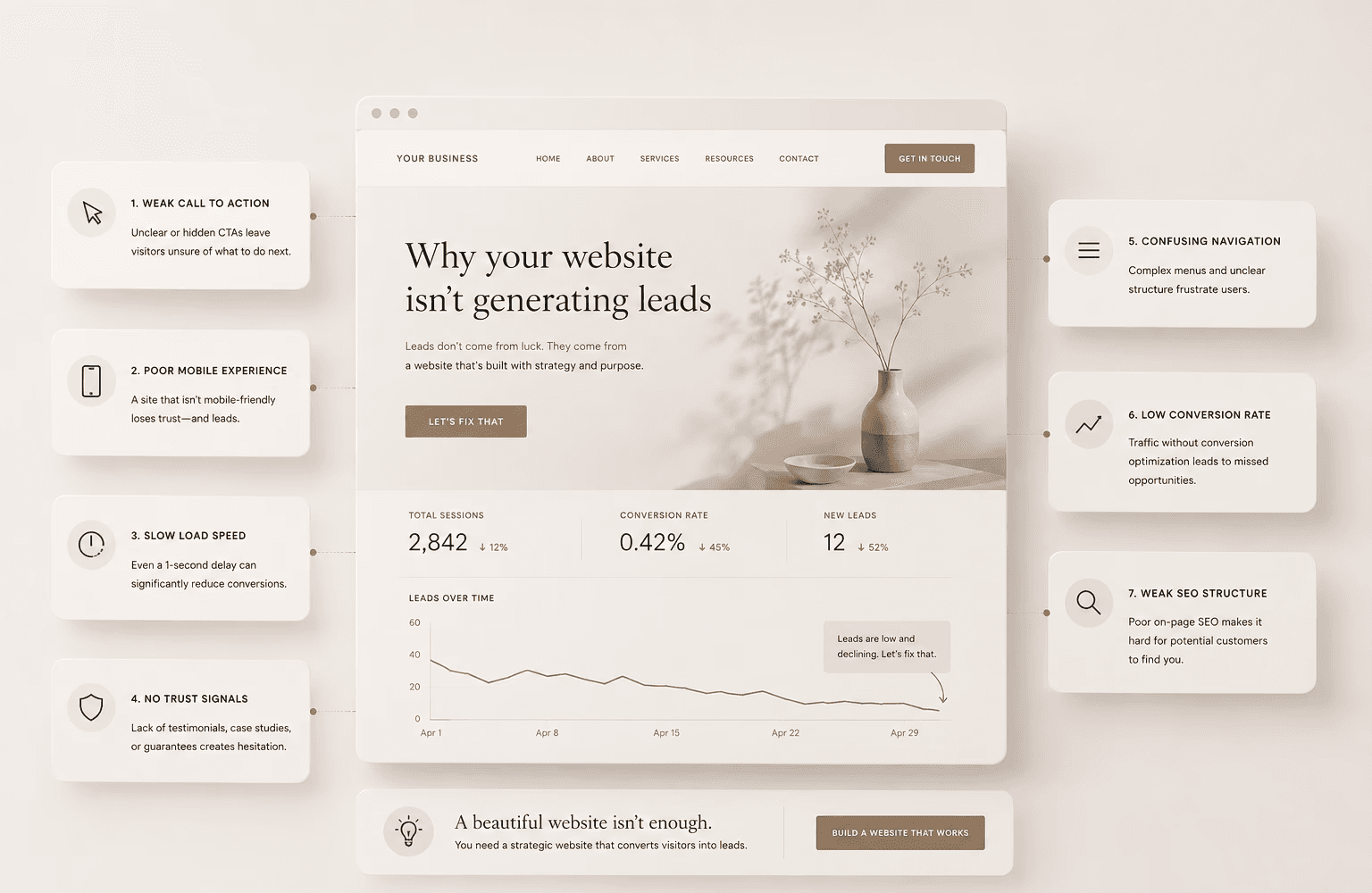
If you’ve been wondering why your website isn’t generating leads, the answer is usually not tied to a single issue. Most websites struggle because of a combination of weak messaging, poor UX conversion strategy, unclear calls to action, and limited SEO optimisation.
In some cases, businesses invest in custom web design but focus so heavily on aesthetics that they overlook how visitors actually interact with the site. Others struggle with visibility altogether, constantly wondering why their website is not showing up on Google while deeper conversion issues continue affecting results behind the scenes. Below, we’ll break down some of the most common reasons websites fail to convert visitors into real enquiries and paying clients.
Your Website Messaging Is Too Vague
One of the most common reasons websites fail to convert visitors into leads is unclear messaging. Visitors should immediately understand what your business offers, who it helps, and why they should trust your brand. Instead, many businesses focus so heavily on visuals during a small business website redesign that the actual communication becomes secondary.
This often creates websites that look polished but fail to explain services in a clear and convincing way. Even with professional custom web design services, poor messaging can quietly hurt engagement, reduce trust, and weaken UX conversion performance over time.
Use clear headlines that explain exactly what your business offers.
Avoid overly generic branding language that creates confusion instead of trust.
Improve SEO optimisation by naturally including relevant service-related keywords.
Guide visitors toward a clear next step with stronger calls to action.
Structure website copy around real customer pain points and questions.
Use custom web design services to improve communication, clarity, and user flow.
Your Website Relies Too Heavily on Templates
Template-based websites can work for simple projects, but they often create limitations when businesses start focusing on growth, SEO performance, and conversions. Many templates prioritise appearance over functionality, leading to repetitive layouts, weak conversion structure, and poor flexibility as your business evolves.
This becomes especially noticeable when companies try to improve rankings or invest in SEO web design services, only to realise their website was never built with long-term performance in mind. While template websites may look visually appealing at first, a custom vs template website comparison usually reveals major differences in scalability, branding, UX conversion, and overall user experience.
Use a website structure built around your specific business goals and audience.
Avoid overly generic layouts that make your brand blend in with competitors.
Improve UX conversion with clearer navigation and stronger page hierarchy.
Invest in SEO web design services that support long-term visibility and performance.
Prioritise mobile responsiveness, loading speed, and flexible page structure.
Consider custom web design services for better scalability and conversion strategy.
Your Website Isn’t Properly Optimised for Search Engines
A visually impressive website will struggle to generate consistent enquiries if people cannot actually find it online. In many cases, why your website isn’t generating leads has less to do with design alone and more to do with weak SEO foundations. Businesses often invest in small business website design services without considering how search engines crawl, understand, and rank the website itself.
Missing metadata, weak page structure, poor internal linking, and unoptimised content can all quietly limit visibility and reduce organic traffic. Even websites with strong visuals and branding can struggle to perform if the SEO strategy behind them is incomplete from the start.
Create an on page SEO checklist for new websites before launching your site.
Use clear heading structure and naturally include relevant keywords across pages.
Improve internal linking between related services, blog posts, and landing pages.
Optimise page titles, meta descriptions, and image alt text for search visibility.
Focus on mobile responsiveness and loading speed to improve user experience.
Small business website design services should support both SEO performance and long-term conversions.
Your Website Feels Outdated or Difficult to Navigate
First impressions play a major role in how visitors perceive your business online. If your website feels outdated, cluttered, slow, or difficult to navigate, users are far more likely to leave before taking action. In many cases, why your website isn’t generating leads comes down to small usability issues that quietly damage trust and create friction throughout the browsing experience.
This is especially common with older websites that have not evolved alongside changing user expectations, mobile behaviour, and modern conversion standards. Businesses researching small business website redesign services often realise that improving navigation, usability, and overall structure can have a far bigger impact on conversions than visual updates alone.
Simplify navigation so visitors can find important information more quickly.
Remove unnecessary sections, cluttered layouts, and distracting elements.
Improve mobile responsiveness to create a smoother browsing experience.
Make calls to action easier to find across key landing pages.
Use cleaner spacing, typography, and page hierarchy to improve readability.
Regularly review website performance and user behaviour to identify friction points.
Your Calls to Action Are Too Weak
Even well-designed websites can struggle to convert if visitors are never clearly guided toward taking action. Many businesses start wondering why website isn’t converting despite getting traffic, only to realise their calls to action are either too vague, difficult to find, or disconnected from the actual user journey.
Others hide important contact options too deep within the website, creating unnecessary friction throughout the browsing experience. Strong calls to action should feel clear, visible, and naturally connected to the content on the page. Looking at high-converting landing pages and established UX conversion examples can also help businesses better understand how strategic CTA placement influences behaviour and engagement.
Use clear calls to action that explain exactly what visitors should do next.
Place contact buttons strategically across high-traffic pages and sections.
Avoid generic CTA text that feels vague or unconvincing.
Reduce unnecessary steps between landing pages and enquiry forms.
Make important conversion actions visible on both desktop and mobile devices.
Match CTA language to the specific intent and needs of your audience.
Your Mobile Experience Creates Friction
Mobile experience has a major impact on whether visitors stay on your website or leave within seconds. In many cases, why your website isn’t generating leads comes down to frustrating mobile layouts, slow loading speeds, or difficult navigation on smaller screens.
Businesses often focus heavily on desktop aesthetics during a small business website design project while overlooking how the site actually performs on phones and tablets. This is also one of the biggest reasons why website isn’t converting despite attracting traffic from search engines or social media. If users have to zoom in, search for buttons, or wait too long for pages to load, conversions usually drop quickly.
Test your website regularly across different mobile devices and screen sizes.
Improve loading speed by reducing oversized images and unnecessary animations.
Make buttons, forms, and navigation easier to use on smaller screens.
Keep important calls to action visible without excessive scrolling.
Simplify layouts to improve readability and overall user experience.
Prioritise mobile responsiveness during every small business website design update.
Your Website Prioritises Launch Speed Over Strategy
Many businesses rush through the website process because they want to launch as quickly as possible. As a result, important elements like SEO structure, UX conversion, content hierarchy, and conversion flow often get overlooked. This is one of the most common reasons why website isn’t converting even after a redesign or visual upgrade.
Businesses often underestimate how much planning goes into building a high-performing website. Questions around how long does it take to build a website usually become far more important once companies realise that rushed timelines can lead to poor structure, inconsistent messaging, and weaker conversion performance. Strong web design services should balance speed with strategy to create a website that performs well long after launch.
Allow enough time for planning, structure, and conversion-focused strategy.
Build website pages around real user behaviour and customer intent.
Prioritise SEO structure and usability before focusing purely on aesthetics.
Test layouts, navigation, and conversion paths before launching the site.
Avoid launching unfinished pages that create confusion or reduce trust.
Choose web design services that balance creativity with long-term performance.
Your Website Doesn’t Build Enough Trust
Trust plays a major role in whether visitors decide to contact your business or leave the website entirely. In many cases, why your website isn’t generating leads has less to do with traffic and more to do with credibility.
If your website lacks testimonials, real project examples, transparent information, or clear service explanations, visitors may hesitate to take the next step. Modern users are far more selective online, especially when comparing multiple businesses offering similar services. Even strong visuals and polished branding can struggle to convert if the website does not feel trustworthy, informative, and professionally structured.
Add testimonials and client feedback throughout important landing pages.
Showcase real projects, case studies, or portfolio examples whenever possible.
Make contact information easy to find across the website.
Clearly explain your services, process, and what clients can expect.
Use consistent branding and clean layouts to improve credibility.
Keep website content updated to avoid making the business feel inactive or outdated.
Your Website Creates Too Much Friction
Small usability issues can quietly damage conversions far more than most businesses realise. Many owners start questioning why website isn’t converting even though traffic numbers appear stable, but the real issue often comes down to friction throughout the user journey.
Long contact forms, confusing navigation, excessive popups, distracting animations, or unclear page structure can make the browsing experience feel frustrating and overwhelming. Modern users expect websites to feel smooth, intuitive, and easy to navigate from the very first interaction. When too many obstacles stand between the visitor and the next step, conversion rates usually begin to decline.
Simplify contact forms by only asking for essential information.
Reduce unnecessary popups and distracting visual elements.
Make navigation cleaner and easier to understand across all pages.
Improve page hierarchy so users can scan content more naturally.
Keep important information accessible without excessive clicking or scrolling.
Focus on creating a smoother and more intuitive user experience overall.
You’re Focusing on Cost Instead of Long-Term Performance
Budget is an important part of any website project, especially for growing businesses. However, choosing the cheapest option without considering long-term performance often creates bigger problems later on. In many cases, why your website isn’t generating leads comes down to decisions made early in the process, including weak structure, poor SEO foundations, limited scalability, and generic user experience.
Businesses researching small business website cost often focus only on the upfront price while overlooking how much a poorly performing website can quietly affect conversions and growth over time. A website should be viewed as a long-term business tool rather than a short-term visual expense.
Prioritise long-term usability and performance over the cheapest possible solution.
Invest in website structure that can support future growth and SEO improvements.
Focus on conversion strategy instead of visuals alone when planning a redesign.
Choose solutions that improve scalability, flexibility, and overall user experience.
Avoid sacrificing speed, mobile responsiveness, or SEO for lower upfront costs.
Treat your website as a long-term business asset rather than a one-time expense.
What a High-Converting Website Actually Needs?
A high-performing website should do far more than simply look visually appealing. It should guide visitors naturally through the experience, build trust quickly, and make taking action feel effortless. In many cases, why your website isn’t generating leads comes down to missing fundamentals like clear messaging, intuitive navigation, strong SEO structure, and effective UX conversion strategy. Even small improvements across these areas can have a noticeable impact on engagement and overall conversion performance over time.
The most effective websites balance aesthetics with usability and long-term strategy. They are built to support both search visibility and real user behaviour instead of focusing purely on trends or visuals alone. From SEO optimisation and mobile responsiveness to trust signals and conversion-focused layouts, every element should work together to create a smoother and more effective user experience.
Website Element | Why It Matters | What Improves Conversions |
|---|---|---|
Clear Messaging | Helps visitors quickly understand your services and value | Strong headlines and clear positioning |
Mobile Responsiveness | Improves usability across all devices | Faster load times and cleaner layouts |
SEO Optimisation | Increases visibility in search engines | Better rankings and qualified traffic |
Calls to Action | Guides users toward conversion | Clear buttons and strategic placement |
User Experience | Reduces friction during navigation | Simpler structure and intuitive flow |
Trust Signals | Builds credibility with potential clients | Testimonials and portfolio examples |
Website Speed | Prevents visitors from leaving too early | Optimised assets and streamlined pages |
Conversion Strategy | Encourages more enquiries and engagement | Better page hierarchy and UX conversion |
Why Your Website Isn’t Generating Leads Often Comes Down to Strategy
A visually appealing website alone is rarely enough to generate consistent enquiries and conversions. In many cases, why your website isn’t generating leads comes down to unclear messaging, poor UX conversion, weak SEO optimisation, and friction throughout the user journey.
Even small usability issues can quietly affect trust, engagement, and overall website performance over time. The most effective websites are built with both strategy and user experience in mind, balancing strong visuals with clarity, functionality, and conversion-focused structure. Improving these areas gradually can make a significant difference in how visitors interact with your business online.
Frequently Asked Questions
Why is my website getting traffic but not generating leads?
This is one of the most common reasons businesses start researching why their website isn't generating leads. In many cases, the problem is not traffic volume but unclear messaging, weak calls to action, poor user experience, limited trust signals, or a website structure that does not guide visitors toward taking action.
What is the 5-minute rule for leads?
The 5-minute rule suggests that businesses should respond to new leads within five minutes whenever possible. Fast responses can significantly improve conversion rates because potential customers are often most engaged immediately after submitting an enquiry.
How can I improve website lead generation?
Improving website lead generation usually involves strengthening calls to action, simplifying navigation, improving website messaging, building trust through testimonials and case studies, and reducing friction throughout the user journey. SEO optimisation can also help attract more qualified traffic.
Can poor website design affect conversions?
Yes. Slow loading speeds, confusing navigation, weak mobile responsiveness, cluttered layouts, and unclear page hierarchy can all reduce conversions. Effective website design should support both usability and business objectives.
Does SEO help generate more leads?
Yes. If you're wondering why your website isn't generating leads, limited search visibility may be part of the problem. SEO helps attract visitors who are actively searching for your products or services, creating more opportunities for enquiries and conversions.
What makes a high-converting website?
High-converting websites combine clear messaging, strong calls to action, mobile responsiveness, fast loading speeds, trust signals, intuitive navigation, and a well-planned conversion strategy. Every element should help visitors move naturally toward becoming a lead or customer.
BLOG