Small Business Website Redesign: How Often Is a Redesign Necessary?
7 MINUTES READ
4 JUNE 2026
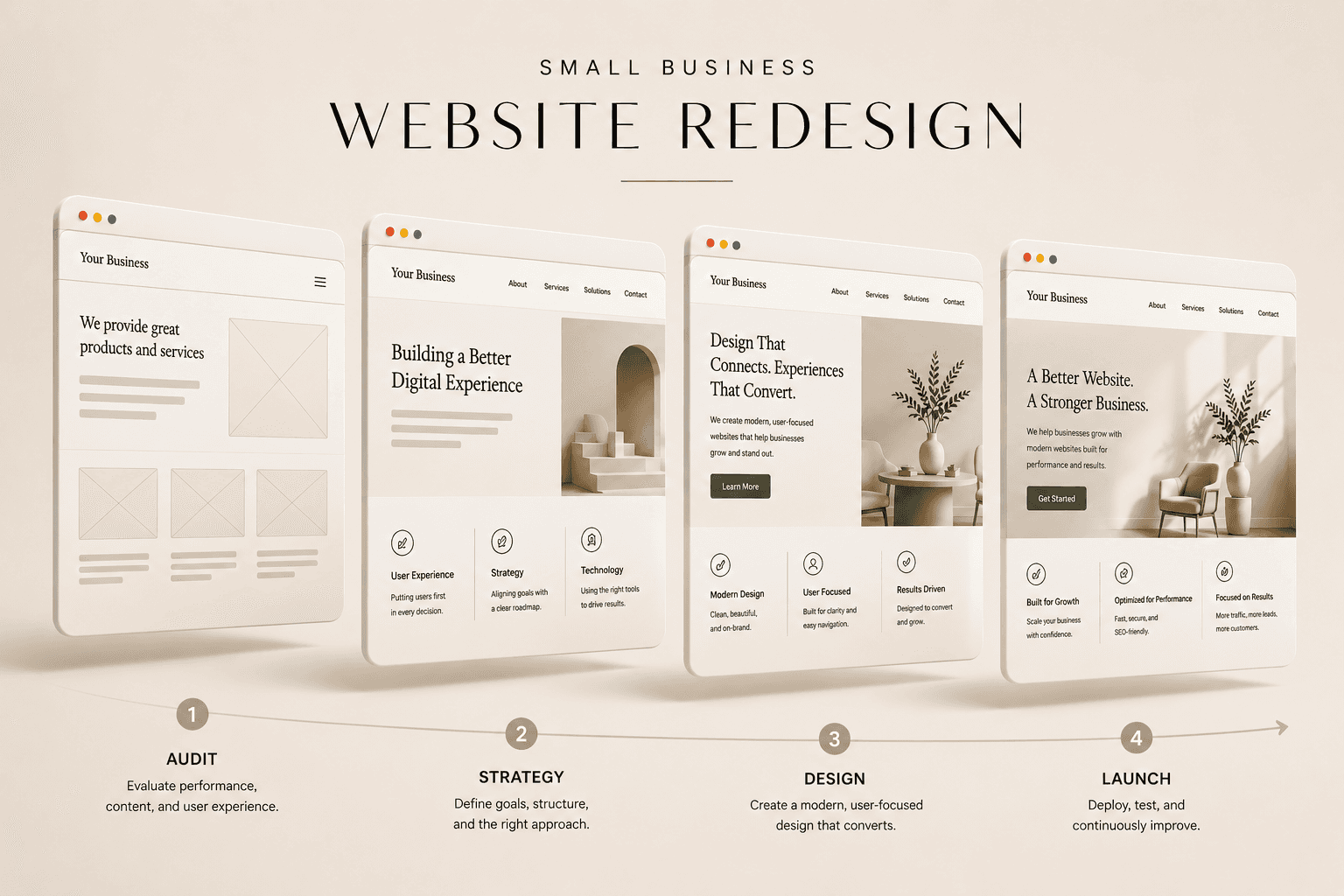
How often should a small business redesign its website? If you've ever looked at your website and felt that it no longer reflects the quality of your business, you're not alone. Many business owners start asking this question when their website begins to feel outdated, enquiries become less consistent, or competitors suddenly seem to have a stronger online presence.
The reality is that websites age in different ways. Sometimes the design starts looking old-fashioned, while in other cases the problem is poor performance, declining conversions, or a frustrating user experience. A successful small business website redesign should be driven by business needs rather than an arbitrary timeline. In this guide, we'll explore how often should a small business redesign its website, the factors that influence timing, and the signs that indicate a small business website redesign may be necessary.
What Is a Small Business Website Redesign?
A small business website redesign involves updating the design, structure, content, and functionality of an existing website to better support current business goals. While some redesigns focus on visual improvements, others address deeper issues such as poor user experience, low conversion rates, outdated technology, or limited search visibility.
Many businesses invest in a small business website redesign when their website no longer reflects their brand or struggles to generate enquiries. Professional web design services for small businesses often include reviewing website performance, improving navigation, updating content, and ensuring the website meets modern user expectations.
When considering how often should a small business redesign its website, it's important to understand that a redesign is not just about appearance. A successful small business website redesign should help improve usability, trust, and overall business performance.
Improved design: Modernise the visual appearance of your website to better reflect your brand.
Better user experience: Make it easier for visitors to navigate your website and find information.
Stronger SEO foundations: Improve website structure and content to support search visibility.
Higher conversion potential: Create clearer pathways that encourage enquiries and customer actions.
Enhanced performance: Address issues related to speed, functionality, and mobile responsiveness.
How Often Should a Small Business Redesign Its Website? 10 Signs It's Time
If you're wondering how often should a small business redesign its website, there is rarely a fixed timeline that works for every business. A small business website redesign is usually driven by performance, user expectations, and business growth rather than age alone. The signs below can help you determine whether a website redesign may be the right next step for your business.
Your Website Looks Outdated: First impressions matter, and visitors often judge a business based on its website. If your design feels several years behind current standards, it may affect credibility and make potential customers question the quality of your services.
You're Getting Fewer Enquiries: A decline in enquiries can be a sign that your website is no longer converting visitors effectively. Even if traffic remains stable, poor user experience or outdated messaging can reduce conversions.
The Mobile Experience Is Poor: More people browse websites on mobile devices than ever before. If your website is difficult to navigate, read, or interact with on a smartphone, you could be losing valuable leads.
Pages Take Too Long to Load: Website speed plays a major role in both user experience and SEO. Slow-loading pages can frustrate visitors and increase the likelihood of them leaving before taking action.
Your Search Visibility Has Stalled: If you regularly find yourself asking why is my website not showing up on Google, the issue may go beyond content alone. An outdated website structure can limit your ability to improve rankings and attract organic traffic.
Visitors Struggle to Find Information: A website should make it easy for users to find services, contact details, and key information. If visitors frequently ask questions that should already be answered on your website, your structure may need improvement.
Your Business Has Evolved: Businesses often expand their services, refine their positioning, or target new audiences over time. When your website no longer reflects your current business, a redesign can help realign your online presence.
You're Outgrowing Your Current Website: Many businesses eventually reach a point where their existing website becomes restrictive. If you're comparing a custom website vs template approach, it may be a sign that your current solution is limiting future growth.
SEO Improvements Feel Difficult: Some websites were never built with search visibility in mind. Businesses investing in SEO web design services often discover that redesigning key areas of their website creates a stronger foundation for long-term SEO growth.
Competitors Have Moved Ahead: If competing businesses offer faster, more modern, and easier-to-use websites, potential customers will notice. A website redesign can help you remain competitive and ensure your online presence reflects the quality of your business.
How Often Should Different Types of Businesses Redesign Their Websites?
There is no universal timeline that applies to every business. While many business owners ask how often should a small business redesign its website, the answer often depends on factors such as industry, competition, customer expectations, and business goals. A local service business, for example, will typically have different redesign needs than an e-commerce store or a growing agency.
The scope of a small business website redesign can also vary significantly from one business to another. Some companies may only need periodic updates, while others benefit from more frequent improvements to maintain performance and competitiveness. Businesses that invest in custom web design often have greater flexibility to evolve their websites over time, making it easier to adapt to changing customer needs and market trends.
Business Type | Recommended Redesign Frequency | Why It Matters |
|---|---|---|
Small Service Business | Every 3–5 years | Service-based businesses typically benefit from periodic updates that improve credibility, user experience, and lead generation. |
Professional Services | Every 2–4 years | Industries such as legal, consulting, and accounting rely heavily on trust, making a modern website particularly important. |
Agency or Creative Studio | Every 2–3 years | Design trends evolve quickly, and agencies need their websites to showcase current capabilities and portfolio work. |
E-commerce Website | Every 1–3 years | Online stores often require more frequent updates to improve conversions, performance, and customer experience. |
SaaS or Technology Company | Every 1–2 years | Rapid changes in technology and customer expectations often require ongoing website improvements. |
Healthcare Practice | Every 3–5 years | Healthcare websites should remain easy to navigate, trustworthy, and aligned with changing patient expectations. |
Local Trades Business | Every 4–6 years | Electricians, plumbers, landscapers, and similar businesses can often keep a website longer, provided it remains functional and mobile-friendly. |
Enterprise Website | Continuous improvements with major redesigns every 3–5 years | Large organisations typically update sections regularly while planning larger redesign projects less frequently. |
Small Service Business
Small service businesses often benefit from a website redesign every three to five years. While some websites can remain effective for longer, changing customer expectations and evolving design standards can gradually reduce performance. If you're wondering how often should a small business redesign its website, service-based businesses should focus on whether their website is still generating enquiries and accurately representing their brand.
Professional Services
Professional service providers such as consultants, accountants, and legal firms rely heavily on trust and credibility. A modern website with strong UX design can help visitors quickly find information and feel confident about making contact. Updating your website every two to four years can help ensure it continues to reflect your expertise and professionalism.
Agency or Creative Studio
Agencies and creative studios typically redesign their websites more frequently than most businesses. Because potential clients often judge creative capabilities based on a company's own website, a small business website redesign may be necessary every two to three years. Regular updates also provide opportunities to showcase new work, services, and industry expertise.
E-commerce Website
E-commerce websites often require the most frequent updates because customer behaviour, technology, and online shopping trends evolve quickly. Redesigns are commonly driven by conversion goals, mobile usability improvements, and performance enhancements. Many online stores review and refine key sections of their website every one to three years to remain competitive.
SaaS or Technology Company
Technology companies operate in rapidly changing markets where customer expectations evolve constantly. For this reason, how often should a small business redesign its website may have a very different answer for SaaS companies than for traditional service businesses. Many technology-focused brands review their website experience every one to two years to keep pace with industry standards.
Healthcare Practice
Healthcare websites generally benefit from updates every three to five years. Patients expect websites that are easy to navigate, mobile-friendly, and capable of providing essential information quickly. Regular improvements can help maintain trust while ensuring the website remains aligned with modern user expectations.
Local Trades Business
Electricians, plumbers, landscapers, and other trades businesses can often keep the same website for longer periods. However, if you're asking how long does SEO take to work, it's important to remember that search visibility depends on more than just website age. Even established websites may require occasional updates to improve content, performance, and local search presence.
Enterprise Website
Large organisations rarely wait several years before making improvements to their websites. Instead, they often implement ongoing updates while planning larger redesign projects every three to five years. Although the scale is different, the same principle applies to a small business website redesign as websites should evolve alongside business goals, customer needs, and technological changes.
How Does a Small Business Website Redesign Affect SEO?
A small business website redesign can have a significant impact on SEO, both positive and negative. When planned correctly, a redesign can improve website structure, user experience, page speed, and content quality, all of which contribute to stronger search performance. However, major website changes without proper planning can also result in temporary ranking losses.
A successful small business website redesign should focus on maintaining existing SEO value while creating opportunities for future growth. It can also be the ideal time to review website architecture, content strategy, and even evaluate how many pages a small business website need to effectively target relevant keywords and customer searches.
Improves Website Structure: A clearer website hierarchy helps search engines understand your content and index pages more effectively.
Creates More Keyword Opportunities: Small business website redesign projects often include new pages, expanded content, and improved topic coverage that can support organic growth.
Enhances User Experience: Better navigation and usability can help visitors find information faster and encourage them to stay on your website longer.
Improves Page Speed: Modern websites are typically faster and more efficient, which can positively influence both rankings and user satisfaction.
Supports Internal Linking: A redesign provides an opportunity to strengthen connections between service pages, blog posts, and other important content.
Increases Mobile Performance: Mobile-friendly websites are essential for both SEO and user experience, particularly as mobile traffic continues to grow.
Helps Target Search Intent: Updated content can better align with the questions and searches your target audience is actively performing.
Requires Careful SEO Planning: Redirects, URL changes, and content updates should be managed correctly to preserve existing rankings and traffic.
How to Approach a Small Business Website Redesign Without Losing SEO?
A small business website redesign can improve performance, user experience, and search visibility, but it should always be approached carefully. One of the biggest mistakes businesses make is changing website structure, URLs, or content without considering the potential SEO impact. If you're wondering how often should a small business redesign its website, it's equally important to understand how to protect existing rankings during the process.
A successful small business website redesign should preserve valuable content, maintain important pages, and build upon existing SEO strengths rather than starting from scratch. It can also be a good opportunity to review factors such as content quality, site architecture, and even how much does a small business website cost when planning future improvements.
Audit Existing Performance: Identify your most valuable pages, keywords, and traffic sources before making any major changes.
Keep Important URLs Where Possible: Maintaining existing URLs can help preserve rankings and reduce the need for redirects.
Use Proper Redirects: If pages must move, implement 301 redirects to ensure visitors and search engines reach the correct content.
Preserve High-Performing Content: Avoid removing pages that already generate traffic, rankings, or enquiries.
Improve Content Strategically: Update and expand existing content rather than replacing it unnecessarily.
Maintain Internal Links: Review internal linking to ensure important pages remain connected after the redesign.
Test Before Launching: Check for broken links, missing pages, mobile issues, and technical SEO problems before going live.
Monitor Results After Launch: Track rankings, traffic, and user behaviour so you can quickly identify and resolve any issues.
How Long Does a Website Redesign Take?
The timeline for a website redesign depends on the size of the website, the complexity of the project, and the amount of content involved. A small business website redesign can sometimes be completed in just a few weeks, while larger projects may take several months.
Businesses investing in professional small business web design services often spend additional time on planning, content updates, SEO considerations, and conversion improvements. If your goal is to address issues such as why your website isn't generating leads, taking the time to get the redesign right is usually worth the investment.
Project Type | Typical Timeline |
|---|---|
Basic Small Business Website | 2–4 weeks |
Small Business Website With Content Updates | 4–6 weeks |
Professional Services Website | 4–8 weeks |
Agency or Creative Studio Website | 6–10 weeks |
E-commerce Website | 8–16 weeks |
Enterprise Website | 3–6+ months |
Website Redesign With SEO Migration | Add 1–3 additional weeks |
Custom Website With Advanced Functionality | 8–20+ weeks |
Ongoing Website Maintenance After a Redesign
A website redesign should not be viewed as a one-time project. Even after a successful launch, ongoing maintenance is essential for keeping your website secure, relevant, and competitive.
A small business website redesign creates a stronger foundation, but long-term results often depend on regular updates and improvements. If you're wondering how often should a small business redesign its website, consistent maintenance can help extend the lifespan of your website and reduce the need for major redesigns in the future.
Keep Content Updated: Regularly review service pages, contact information, and business details to ensure everything remains accurate and relevant.
Monitor Website Performance: Track traffic, conversions, and user behaviour to identify opportunities for improvement before problems become significant.
Update Plugins and Software: Keeping your website platform, plugins, and integrations updated helps maintain security and functionality.
Review SEO Performance: Monitor rankings, organic traffic, and keyword performance to ensure your website continues attracting relevant visitors.
Test User Experience: Periodically review navigation, forms, and key user journeys to identify potential usability issues.
Improve Existing Pages: Updating and expanding content over time can often provide better results than constantly creating new pages.
Check Mobile Performance: Mobile expectations continue to evolve, making regular testing an important part of website maintenance.
Plan Future Improvements: A small business website redesign should be supported by ongoing optimisation rather than waiting until the website becomes outdated again.
What Can a Small Business Website Redesign Include?
Not every redesign project involves rebuilding a website from the ground up. The scope of a small business website redesign can vary significantly depending on your goals, budget, and the challenges you're trying to solve. Some businesses only need visual updates and content improvements, while others require major structural changes, new functionality, or a completely different platform.
The right approach depends on the current state of your website and what you want it to achieve moving forward. Businesses investing in small business web design often discover that redesign projects can address far more than appearance alone. From improving SEO and user experience to introducing new features and modern technology, the scope of a redesign can be tailored to your specific needs.
Redesign Element | What It May Include |
|---|---|
New Branding | Updated colours, typography, imagery, messaging, and visual identity. |
Complete Restructuring | New navigation, page hierarchy, user journeys, and website architecture. |
New CMS or Platform | Migration to a different website platform or content management system. |
SEO Overhaul | Improved website structure, content optimisation, internal linking, and technical SEO. |
New Functionality | Online bookings, custom forms, memberships, portals, calculators, or integrations. |
Mobile-First Redevelopment | Rebuilding the website with mobile users as the primary focus. |
Content Refresh | Rewriting outdated content, improving messaging, and updating service information. |
UX Improvements | Better navigation, usability, accessibility, and conversion-focused design. |
Performance Optimisation | Faster loading speeds, cleaner code, and improved website performance. |
Conversion Optimisation | Stronger calls to action, improved layouts, and better lead generation opportunities. |
Small Business Website Redesign vs Website Refresh: What's the Difference?
A small business website redesign and a website refresh are often used interchangeably, but they involve very different levels of change. A refresh typically focuses on updating existing elements such as content, imagery, colours, or minor design details without significantly altering the website's structure. A redesign, on the other hand, involves more substantial improvements that may affect navigation, page layouts, functionality, user experience, and SEO performance.
Understanding the difference can help businesses choose the right solution based on their goals and budget. Businesses exploring small business web design services often discover that a refresh is enough to modernise an existing website, while others require a complete redesign to improve performance, support future growth, or implement a stronger on-page SEO strategy.
Website Refresh | Website Redesign |
|---|---|
Updates existing content and visuals | Rebuilds key parts of the website structure |
Minor design improvements | Significant visual and functional changes |
Retains most existing pages | May involve new pages and navigation |
Faster implementation | Longer project timeline |
Lower investment | Larger investment |
Suitable for relatively modern websites | Often needed for outdated or underperforming websites |
Limited SEO improvements | Opportunity for broader SEO and UX enhancements |
Focuses on refinement | Focuses on transformation |
Refresh vs Redesign: How to Decide?
Choosing between a refresh and a website redesign often comes down to the severity of the issues you're trying to solve. If your website still performs well, looks relatively modern, and meets your business goals, a refresh may be enough. Updates such as new content, improved imagery, refreshed branding, or minor design adjustments can often extend the life of a website without requiring major changes.
However, if your website struggles to generate enquiries, delivers a poor user experience, or no longer reflects your business, a small business website redesign may be the better option. If you're wondering how often should a small business redesign its website, the answer is usually tied to performance rather than age. When structural, SEO, or usability issues start affecting results, a redesign often provides a more effective long-term solution than a simple refresh.
How Often Should a Small Business Redesign Its Website?
There is no fixed timeline that works for every business, but understanding how often should a small business redesign its website can help you make more informed decisions about your online presence. Rather than focusing solely on age, it's important to evaluate factors such as performance, user experience, search visibility, and business growth.
A small business website redesign should be viewed as an investment in the future of your business rather than a cosmetic update. Whether your goal is to improve SEO, generate more enquiries, enhance usability, or better reflect your brand, the right redesign strategy can help ensure your website continues to support your business for years to come.
Frequently Asked Questions
How often should a small business website be redesigned?
Most small businesses benefit from reviewing their website every few years and considering a redesign every three to five years. However, the ideal timeline depends on factors such as website performance, industry trends, customer expectations, and changes within the business itself.
What is included in a small business website redesign?
A website redesign can include visual updates, improved navigation, content revisions, mobile optimisation, SEO improvements, performance enhancements, and new functionality. Some projects focus on refreshing existing elements, while others involve rebuilding significant parts of the website.
Can a website redesign improve SEO?
Yes, a website redesign can improve SEO when it is planned correctly. A redesign provides opportunities to improve website structure, page speed, user experience, internal linking, content quality, and technical SEO, all of which can contribute to stronger search visibility.
How long does a website redesign take?
The timeline varies depending on the size and complexity of the project. A basic small business website redesign may take two to four weeks, while larger websites with custom functionality, extensive content updates, or SEO requirements can take several months.
How much does a website redesign cost?
Website redesign costs vary significantly based on the scope of the project. Factors such as the number of pages, content requirements, custom functionality, SEO work, and design complexity all influence the final investment.
What is the difference between a website refresh and a website redesign?
A website refresh focuses on improving existing elements such as content, imagery, branding, and minor design details. A website redesign involves more substantial changes to the website's structure, functionality, user experience, and overall performance.
BLOG